
If water has started cutting into a slope, a creek bank, or the shoulder of your road, it will not stop on its own. Each runoff event carries away a little more soil, the channel gets deeper, and the deeper channel concentrates the next flow harder. That is why erosion always looks slow right up until the season it takes out a driveway. The fix is not rock everywhere — it is matching the method to where the water is actually doing damage, and relieving the water that is causing it.
Why Montana ground gives way
Most of our erosion comes from a few weeks a year. Spring runoff dumps months of accumulated snowpack through drainages that are dry by August, and it does it while the ground is still saturated and the vegetation has not greened up. Freeze-thaw loosens the top few inches all winter, so when the melt arrives there is a layer of unconsolidated soil sitting there ready to move. Add the steep alluvial fans coming off the Absarokas and the Gallatins, the sandy and gravelly soils in the valley bottoms, and a short growing season that limits when new cover can establish, and you have ground that erodes fast and heals slowly.
Read the water before you place rock
Every assessment starts uphill of the damage, not at it. We walk the contributing area to find out how much water reaches that point and how it gets there — sheet flow off a pasture behaves nothing like a concentrated jet coming out of an undersized culvert. Then we look at the failure itself: is the bank being undercut at the toe, is the face sloughing because it is too steep for the soil, or is water getting behind the slope and pushing it out? Those three failures look similar from the top and need completely different repairs.
| What you see | Usual cause | What actually fixes it |
|---|---|---|
| Bank cut back at the waterline, overhang above | Toe scour from stream or ditch flow | Riprap keyed in below the scour line |
| Fan of soil and rock below a pipe | Culvert outlet velocity with no apron | Rock outlet protection, sized to the flow |
| Small parallel rills on a bare slope | Sheet flow with no vegetation | Regrade, seed, and cover |
| Deep single gully | Concentrated runoff from above | Intercept upslope, then rebuild the channel |
| Slope face bulging or slumping | Groundwater and too steep an angle | Reshape, drain, or wall it |
Riprap, done so it stays
Riprap works by armoring the surface so water runs over stone rather than soil. Three things decide whether it holds. Sizing comes first — stone has to be heavy enough for the velocity at that spot, and undersized rock simply leaves with the bank it was supposed to protect. Second, it needs to key into the toe below the scour line, because almost every riprap failure starts at the bottom and unravels upward. Third, it needs bedding or filter fabric underneath, otherwise the current pulls fine soil out through the voids and the rock settles into a hole of its own making. Angular quarried stone locks together; round river cobble rolls. We handle placement and delivered materials together so the stone showing up on site is the stone the job actually calls for.
Seeding, grading, and taking the pressure off
Rock is the wrong tool for broad ground. A pasture slope, a reclaimed cut, or a rebuilt bank above the waterline is better held by roots. That means reshaping the face to an angle the soil can hold, saving and respreading topsoil, seeding, and protecting the seedbed with mulch or blanket until it takes. Where the ground is too steep to lay back, retaining and boulder walls buy back the angle and the usable land at the same time.
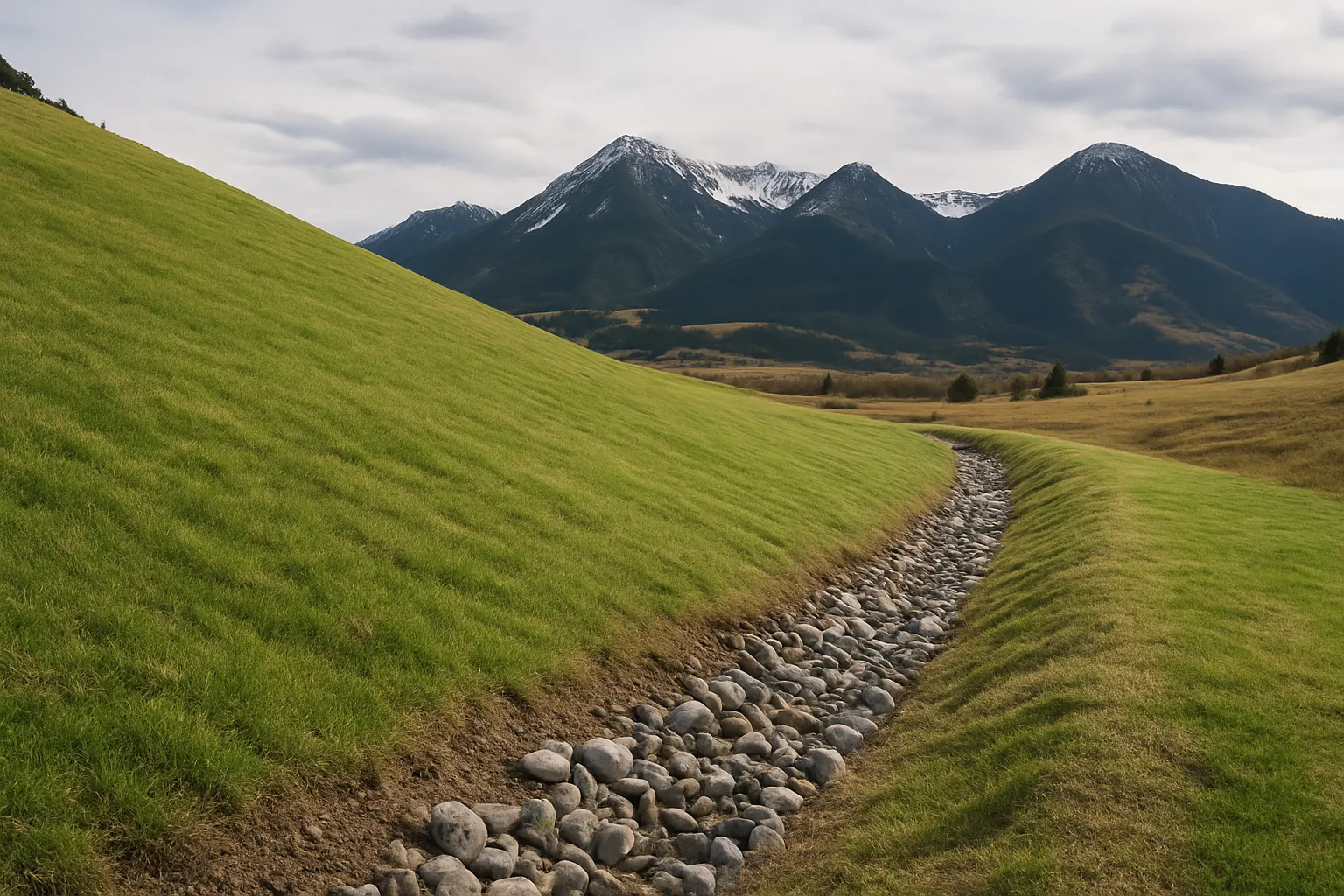
The piece owners skip most often is upstream relief. Ditches and swales and a properly sized culvert move water past a vulnerable face instead of across it, which is the whole argument of our Montana rural drainage guide. Armoring a slope while leaving the runoff pointed at it is a temporary repair with a heavy price tag.
What to walk before spring
Inspect after the first hard melt and again after any summer cloudburst. Look for new soil fans at pipe outlets, exposed roots or leaning fence posts along a bank, cracks running parallel to the top of a slope, and gravel from your road showing up somewhere downhill. Fresh rills the width of your hand are the cheapest problem you will ever fix; the same feature next spring is a gully that needs equipment.
Scope depends on how much water the site takes, how far equipment has to reach the failure, whether the stone can be dumped from the bank or has to be placed piece by piece, haul distance for rock and topsoil, and whether the work touches a regulated stream. A ditch outlet reached from a two-track is a different job than a creek bank a hundred yards from the nearest access.
Losing ground to runoff around Emigrant, Pray, or Gardiner? Call (406) 623-9075 or request a free estimate, and we will look at where the water is coming from before quoting what to build. See our erosion control services for the full range.
Have a project in mind?
EZ Road Repair handles road building, excavation, drainage, masonry, and snow work across Paradise Valley and Southwestern Montana.