
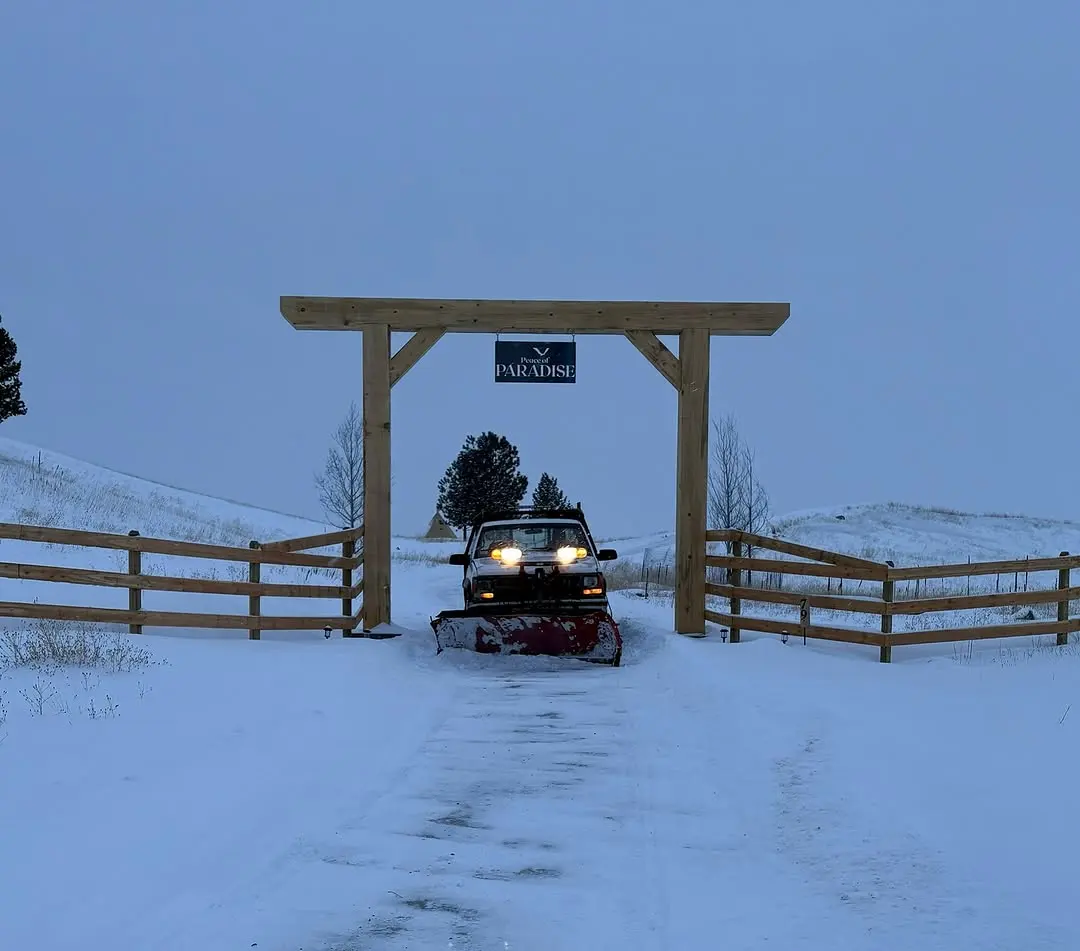
Keep the road open. All winter, not just the morning after.
Snow Removal in Paradise Valley, Montana
Winter here doesn’t do anything halfway. Between heavy snowfall and the wind that drifts a cleared driveway shut by morning, keeping access open is a season-long job. EZ Road Repair plows, sands, and hauls snow across Emigrant, Livingston, Pray, Chico, Gardiner, and the rest of Paradise Valley — long ranch driveways, shared subdivision roads, business lots, and mountain-bench properties that the county plow never touches. We build and maintain these same roads the rest of the year, so on most properties we already know what is under the snow.
When this matters
- A driveway or private road you can’t get a vehicle out of after an overnight storm
- Wind-loaded stretches that fill back in within hours of being cleared
- Steep or north-facing drives that glaze over and stay iced for weeks
- Business lots and entrances that have to be open and walkable before customers show up
- Snow banks tall enough that the plow has nowhere left to push
- Shared roads where nobody has sorted out who is clearing what
- Meltwater running across the road and refreezing because the banks have it trapped
Wind is the real problem, not snowfall
Eight inches behind a hard valley wind causes more trouble than two feet that falls straight down. Paradise Valley funnels wind between the Absarokas and the Gallatins, and any driveway that runs across the prevailing direction will load up long after the storm has quit. That is why a drive can be plowed clean at dawn and be impassable by mid-afternoon under a blue sky.
How the banks are shaped decides how much of that you live with. A snow bank left tall and vertical along the upwind edge behaves exactly like a snow fence: it slows the wind and drops its load right onto the surface you just cleared. Banks pushed well back from the road edge and laid back at a slope let the wind carry snow across instead of dumping it. That is also why the first storms of the season matter more than people expect — where snow goes in November sets the width you still have to work with in February, and banks pushed back early keep the same driveway open with far less effort all winter.
Plowing gravel is not the same as plowing pavement
Most driveways and private roads out here are gravel or road mix, and an operator who plows them like a paved lot will move the surface into the barrow ditch by spring. The cutting edge has to ride slightly high, leaving a thin compacted layer of snow as a wear surface, so the blade shears snow instead of peeling off the top inch of gravel. Done wrong, you spend the summer replacing material that ended up in the ditch and out in the yard.
Marking matters just as much. Before the ground freezes, driveway edges, culvert ends, water valves, septic lids, gate posts, and turnaround limits should be staked, because once there is snow on everything the operator is working from memory and outline. It is also worth agreeing ahead of time where piles go: not over a drain field, not where it blocks the sight line pulling onto the highway, not against a building where the melt runs back under a wall, and not stacked on the low side where meltwater has to cross the drive.
Ice is its own problem. On shaded north pitches and in the freeze-thaw stretches of late winter, sun melts the surface at midday and it refreezes to sheet ice overnight. Rock salt loses most of its practical value once temperatures sit in the teens, which is why sand and cinders on the steep and shaded sections are the sensible Montana answer for gravel and rural sites.
Per-storm, seasonal, or emergency
Snow work gets arranged three ways, and the right one depends on how much risk you can carry. Residential snow removal suits homeowners with a single drive who are fine calling after a storm. Commercial plowing is scheduled around opening hours, entrances, and where piles can sit without eating parking stalls. Seasonal snow plowing contracts put your property on the route plan before the season starts instead of leaving you calling around during a storm cycle. When the banks run out of room, snow hauling and pile removal takes the piles off site entirely. And 24/7 emergency snow and ice control is for the storm that shuts access when you can’t wait for the regular rotation.
How we approach it
We start by walking the property before the snow flies — marking hazards, agreeing on pile locations, checking turnarounds, and noting the pinch points where wind loads. From there we set the plan, per-storm or seasonal. Through the winter it is a matter of holding width rather than just clearing tracks: pushing banks back, breaking berms at the low spots so melt can leave the surface, keeping culvert inlets open so a February thaw doesn’t run over the road, sanding the pitches, and hauling piles once there is nowhere left to put them. When spring melt shows where water is actually going, we can carry the same job into drainage work and road maintenance — regrading crown, repairing the soft spots, and fixing the reason snowmelt kept ponding in the first place.
Serving Paradise Valley & Southwestern Montana
Based in Emigrant, we clear snow throughout Paradise Valley — Livingston, Pray, Chico, Gardiner, and the surrounding ranch and mountain properties, including long private drives and shared roads well off the pavement.
Get a snow removal estimate
Call (406) 623-9075 or request a quote before the season fills up. Tell us how long the drive is, how it sits to the wind, and whether you want per-storm or seasonal service, and we’ll give you a straight estimate.
EZ Road Repair and Excavation — locally owned, Montana tough.