
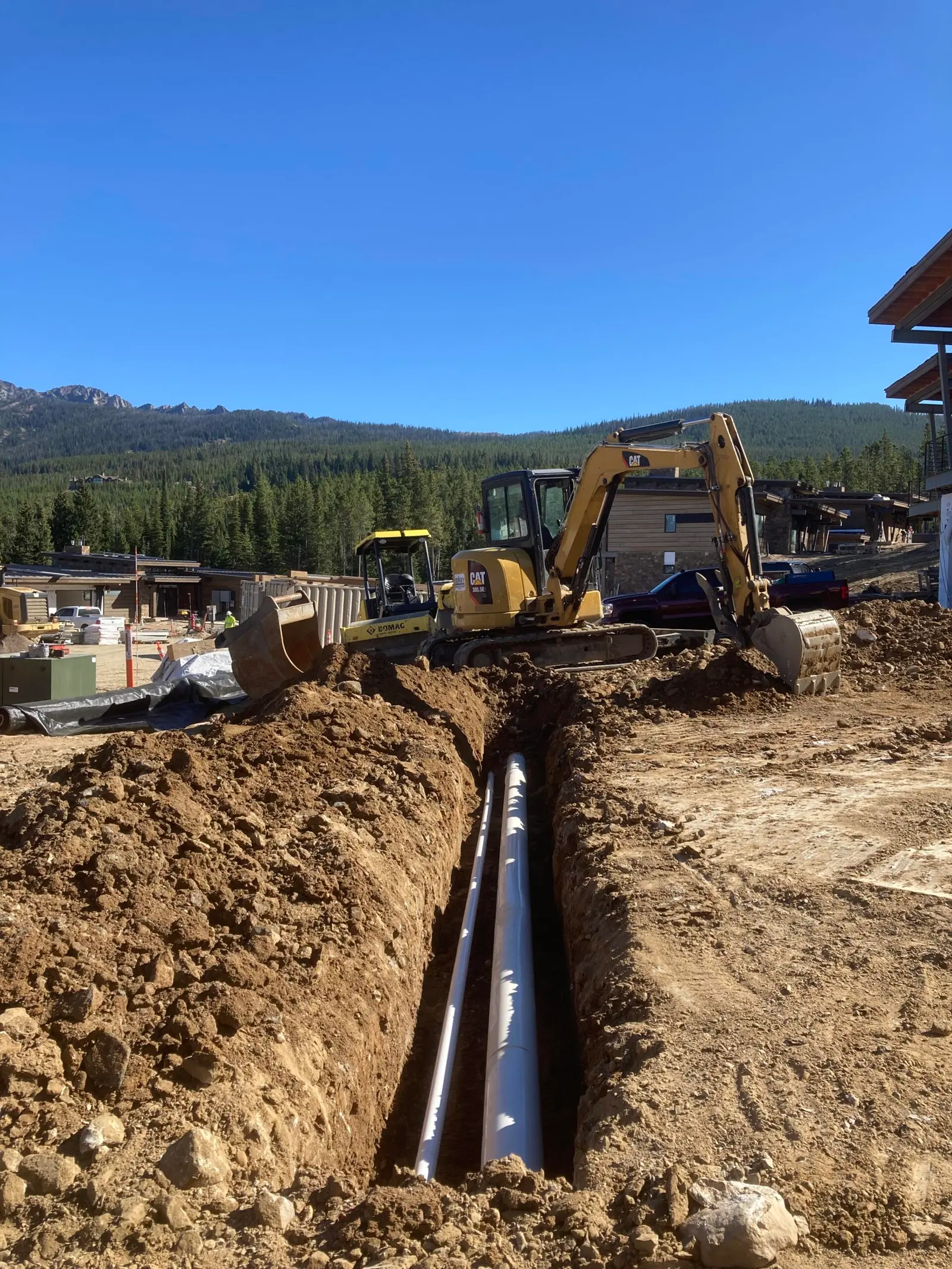
Water goes under the driveway, or it goes over it. There is no third option.
Culvert Installation & Repair in Paradise Valley, Montana
A culvert is a small piece of a property that causes big problems when it’s wrong. Too small, set too high, plugged with ice, or crushed under the traffic above it, and the next runoff crosses your driveway instead of going under it — leaving a rutted approach or a crossing you can’t get a truck over. EZ Road Repair installs, replaces, and cleans culverts across Emigrant, Livingston, Pray, Gardiner, Chico, and the rest of Paradise Valley, sized for the water they carry in a heavy May.
When this matters
- Runoff crosses your driveway on the surface every spring and cuts a channel through it
- The pipe you have runs full, backs up behind the inlet, and spills around the ends
- A culvert is crushed, rusted through at the bottom, or separated at a joint
- The outlet has scoured a hole and the pipe end is starting to hang in the air
- Sediment, hay, willow, or beaver work has plugged the barrel
- You’re building a new approach off a county road or a road to a back pasture
Sizing and setting the pipe
Sizing starts with what’s upstream: how many acres drain to this point, how steep it is, whether it’s timber, sage, or irrigated hay, and what the channel does when snow comes off fast. A pipe that handles an average year and drowns in a big one isn’t sized — it’s guessed at. Rural driveway crossings usually start around 15 to 18 inches for a reason: anything smaller plugs with ice and debris long before it runs out of capacity.
Placement matters as much as diameter. The invert — the bottom of the pipe — sits at or slightly below the flowline of the ditch, so water enters without ponding and silt doesn’t build a bar at the mouth. The barrel is laid on grade with the channel, in the same 1 to 2 percent range we build ditches to — enough fall to keep the pipe scouring itself clean without tearing up the outlet. The pipe also follows the natural line of the water, even when that means skewing it across the driveway instead of running it square. Water that has to turn to find an inlet will eventually go around it.
Underneath, it’s a bedding and compaction job. The pipe sits on shaped, compacted bedding — not on cobble, not on frozen clods — and backfill goes in in lifts, compacted into the haunches on both sides. That side support is what carries the load. Most crushed culverts we pull out weren’t crushed by trucks; they were dropped in a trench, backfilled with loose native rock, and left with voids along the springline. Cover matters too: roughly a foot of compacted material over the pipe is a common minimum, more under heavy equipment.
Inlets, outlets, and the ends that fail first
A bare inlet lets the fill slope ravel back into the ditch until the shoulder is undercut; a bare outlet lets falling water dig a plunge pool that removes the ground the pipe rests on. A rock or stone masonry headwall holds the embankment face, helps water enter cleanly instead of swirling at the mouth, and keeps the end from being clipped by a plow blade. Downstream, an armored apron of properly sized rock spreads the energy where it lands — erosion control protecting the pipe behind it.
What Montana does to a culvert
Freeze-thaw is the hard part. A culvert that trickles all winter can freeze from the outlet back until the barrel is a solid plug of ice — then the melt arrives in March with nowhere to go, running over the road on frozen ground that won’t take a drop. Grade, diameter, and an outlet that isn’t buried under a plow berm are what keep a pipe from icing shut. Pipe bedded in saturated ground settles at the joints and pulls apart. Galvanized steel rusts at the invert first, where water sits, so a pipe can look sound from the ends and be gone along the bottom.
The calendar is the other constraint. A crossing that has to be dug has to be dug in unfrozen ground, and the window between runoff and hard freeze is short. Fall is the time to replace a marginal pipe; spring is when you find out you should have. If the crossing is a live stream rather than a ditch or seasonal draw, work in the bed or banks generally requires a 310 permit through the local conservation district, and we’ll say so rather than putting a bucket in the water.
How we approach it
We walk the drainage first, not just the crossing — where the water comes from, where it should go, and what recent springs did to it. From there we size the pipe and set the grade, then handle excavation and removal of the old pipe, bedding and backfill compacted in lifts, headwall and outlet armoring, and grading and surfacing to tie the approach back together with road mix or gravel. When the pipe is one symptom of a bigger water problem, we’d rather solve the whole thing — ditches, drainage, and spring runoff repairs — than set new pipe and watch it plug again. A culvert that is only full gets cleaned out and re-armored instead.
Serving Paradise Valley & Southwestern Montana
Based in Emigrant, we install and repair culverts throughout Paradise Valley — Livingston, Pray, Gardiner, Chico — and the surrounding ranch and mountain properties, from one driveway crossing to a string of pipes on a private road.
Get a culvert estimate
Call (406) 623-9075 or request a quote. Tell us where the water crosses and what it did last spring, and we’ll look at the site, size it right, and give you a straight estimate.
EZ Road Repair and Excavation — locally owned, Montana tough.