
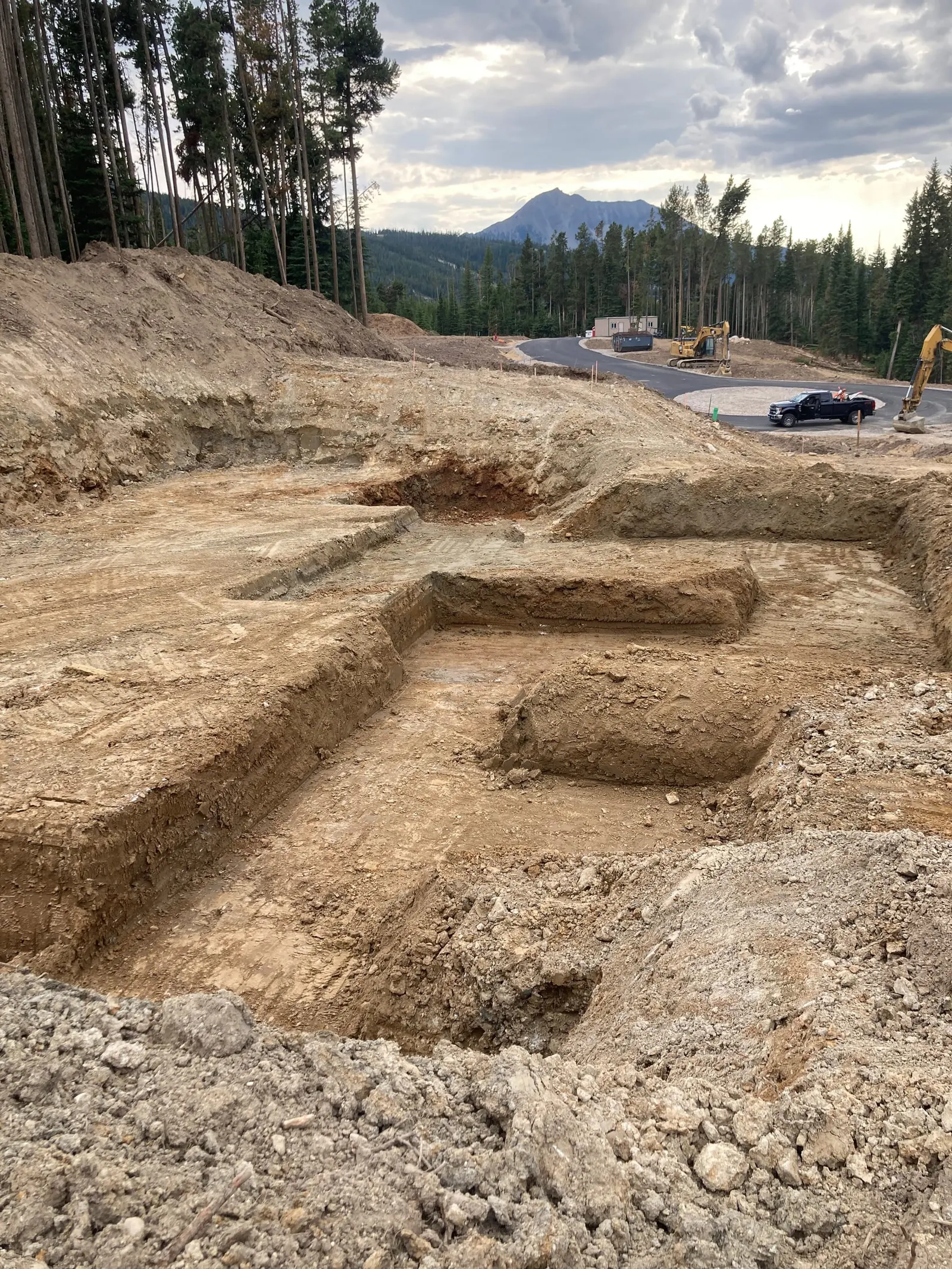
Every project out here starts with ground that has to be opened, moved, or made level.
Excavation Services in Paradise Valley, Montana
EZ Road Repair is a locally owned excavation outfit based in Emigrant. We dig foundations, cut pads, trench utilities, and reshape ground across Livingston, Pray, Chico, Gardiner, and the length of Paradise Valley. Excavation is the part of a project nobody notices when it’s finished and everybody fights when it’s done wrong — a footing bearing on disturbed soil, a pad that settles under one corner of a slab. This page is the hub for that work: ground opened, moved, shaped, or made ready to build on.
When this matters
- You’re building a house, shop, cabin, or addition and need a foundation or basement dug
- A raw parcel needs a building envelope, a driveway cut in, and water and power brought to it
- Water, power, or a septic line has to be trenched across the property
- Ground around a structure sheds water toward the building instead of away from it
- A pad, slab, or outbuilding site has settled, cracked, or never sat level to begin with
- You bought acreage with no road, no pad, and no obvious place to start
What Montana ground does to a dig
Soils change fast here, sometimes inside a single property line. The valley floor holds clay pockets that swell when wet and turn greasy under a track machine. The benches above are glacial cobble and river rock that drain fast but shift under load. Higher up you hit bedrock and boulders that no amount of scheduling optimism will move on their own. Two neighbors a quarter mile apart can need two entirely different approaches, which is why an estimate written off a satellite photo is worth about what it costs.
Then there’s frost. Freeze-thaw is the engine behind most of the failures we get called out to fix. Water sitting in or under a structure freezes, expands, lifts whatever is above it, and leaves a void behind when it thaws. That’s why footings have to bear below frost depth on clean, undisturbed ground, why water lines get buried several feet down rather than at the depth that works in milder country, and why backfill has to go back in compacted lifts instead of being pushed into the hole in one pass. Frost depth isn’t one number here either — it varies with elevation, aspect, soil, and snow cover.
Spring runoff is the other force to design around. Snowmelt off the Absarokas moves a lot of water through this valley in a short window, and it finds every low spot, every uncompacted trench line, and every cut left with nowhere to drain. An excavation that looks fine in August tells the truth in April.
Where excavations go wrong
- Digging before locates. Buried water, power, gas, and fiber don’t always run where anyone remembers putting them. Locates come before the bucket.
- Disturbing the bearing surface. Overdigging and then filling back to grade with loose spoil puts a footing or slab on material that will consolidate under load. The bottom of the hole should be left clean, level, and undisturbed.
- Backfill dumped instead of built. Trench and foundation backfill placed in one lift keeps settling for years. It goes back in lifts, compacted, or the trench reappears as a rut running across the yard.
- Spoil piled uphill of the cut. Loose material stacked above an open excavation loads the slope and washes back into the hole with the first hard rain.
- No plan for the water. A dig that leaves a low spot with no outlet becomes a pond. Grade and drainage get decided before the machine leaves, not after the fact.
- Running past the season. The building window here is short. Deep trenching and earthwork get much harder once frost sets in, and a job started too late often sits until spring.
Excavation, earth moving, or site prep?
People use these interchangeably, so here’s how we split them. Moving large volumes of material — balancing cut and fill, importing or hauling off dirt, reshaping a whole parcel — is bulk excavation and earth moving. Taking a lot from raw or built-on to build-ready, including clearing, demolition, and the full sequence, is site preparation and demolition. Precision digging for structures — footings, foundations, basements, and trenches — is excavation proper. Most jobs need some of each, and the same crew handles all of it.
How we approach it
We walk the site first — soil, slope, access, and where the water goes — and get utility locates in hand before anything is opened. From there the sequence is usually the same: strip and stockpile topsoil for final grading, cut to grade, and plan the equipment path so we aren’t driving loaded machines back across ground we just built. Structural digs go to the depth and grade the plans call for, with the bearing surface left clean and undisturbed. Utility trenches — water below frost depth, everything else at the depth its code requires — get bedded, backfilled in lifts, and compacted. In Park County we handle septic system excavation and drain field work as well. Pads get built up in compacted lifts rather than dumped and shaped. Before we pull off the site, the drainage gets set — ground shaped so runoff moves away from the structure, with ditches, swales, or culverts wherever the site needs them.
Serving Paradise Valley & Southwestern Montana
Based in Emigrant, we excavate throughout Paradise Valley — Livingston, Pray, Chico, Gardiner — and take on work out toward Bozeman and Big Timber.
Get an excavation estimate
Call (406) 623-9075 or request a quote. Tell us what you’re building, what the ground looks like now, and when you need to be in it, and we’ll walk the site with you and put together a straight estimate.
EZ Road Repair and Excavation — locally owned, Montana tough.