
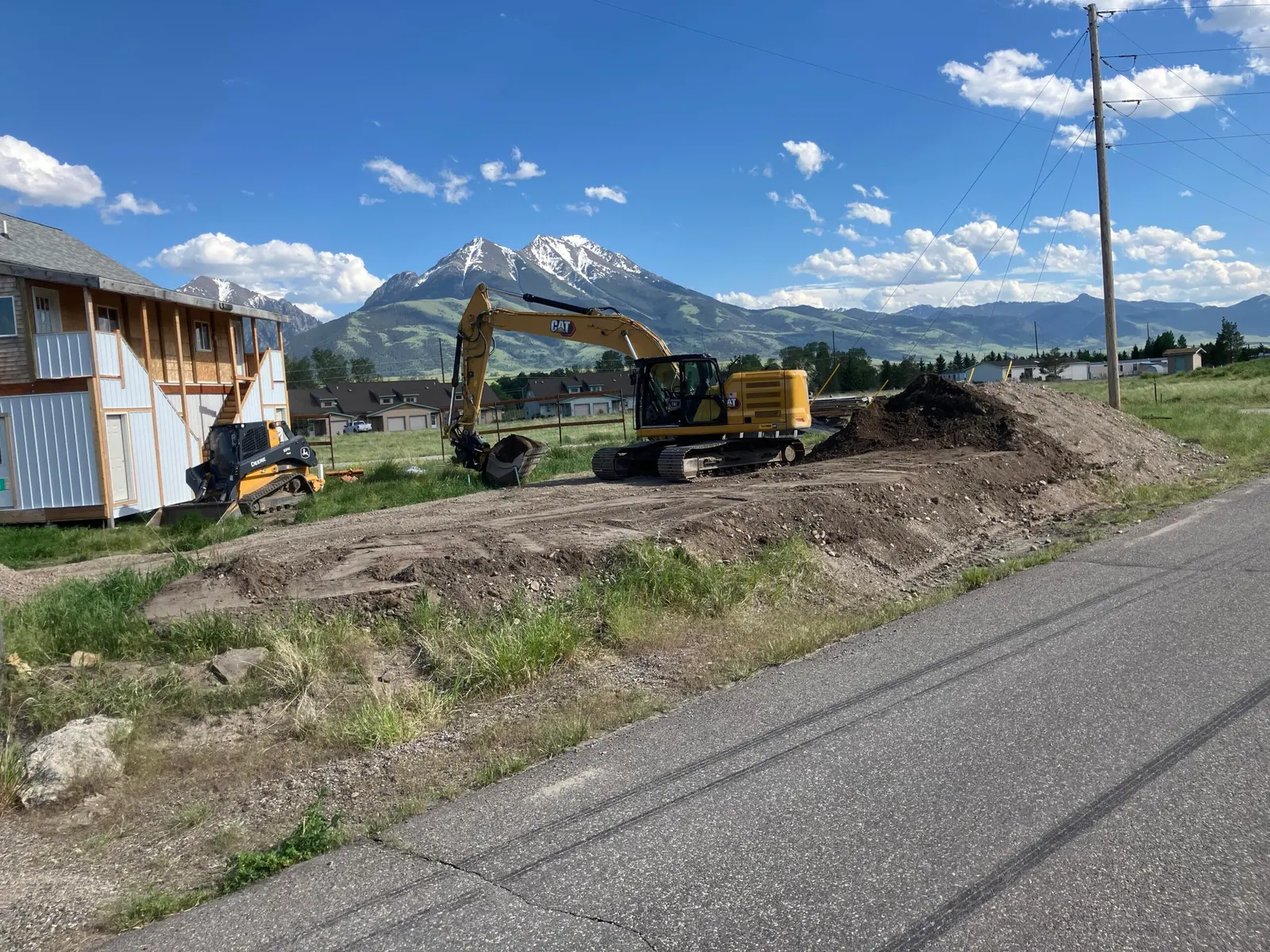
When a road fails in the same three spots every year, the surface is not the problem.
Road Construction & Repair in Paradise Valley, Montana
EZ Road Repair rebuilds failed private roads, ranch roads, shared subdivision roads, and long driveways across Emigrant, Livingston, Pray, Gardiner, Chico, and the length of Paradise Valley. This is repair in the real sense — not another blade pass over a road that has already come apart, but finding out why it came apart and fixing that. Most of the roads we get called to look at share a history: built thin, built in a hurry, never drained, and bladed once a year ever since. A road like that can be brought back — from the bottom.
When this matters
- Potholes, ruts, and washboard return within weeks of a fresh grading
- A stretch turns soupy every spring and stays that way through mud season
- Snowmelt or a hard rain cut a channel across the road or straight down it
- The road pumps and shoves under a loaded truck — soft spots that move when weight crosses them
- Gravel keeps disappearing into the road instead of staying on top of it
- The road is fine in August and impassable in April
What is actually failing under the surface
A gravel road is a structure with three parts: a shaped subgrade, a compacted base, and a wearing surface. When a road fails, one of the first two has usually given up — and grading only reshapes the third.
Subgrade failure is the deep one. Native soil under the road gets saturated, loses bearing strength, and starts moving under traffic. Aggregate from the surface gets pumped down into that soft material, so the road eats rock without ever getting thicker. You can haul gravel onto that road for years and it will keep swallowing it. The fix is to excavate the failed material, dry or replace it, and in bad ground put a separation fabric between subgrade and base so the two layers stay two layers instead of blending into one weak one.
Base failure is largely what freeze-thaw does to us here. Water trapped in the base freezes and expands, breaking the interlock between compacted stones, and the thaw leaves a loose layer exactly where the strength was supposed to be. That is why so many roads in this valley look acceptable in October and come apart in March: the damage happened over the winter and only shows the week the frost comes out.
Shape failure feeds both of the above. A road that has lost its crown ponds water instead of shedding it, and a road with silted-in ditches has nowhere to put the water it does shed. Roughly 2 to 4 percent of crown moves water off a driving surface; ditches want a steady fall, generally on the order of 1 to 2 percent, so they carry water away rather than hold it alongside the road.
Repair, rebuild, or maintain?
Three different jobs, and it is worth knowing which one you are buying. Grading and gravel on a road that still has its structure is road maintenance — the cheapest money in this business. Repair is what this page covers: a road that has failed in places and needs those sections rebuilt, the drainage corrected, and the surface reestablished across the whole run. A new alignment, or a road rebuilt end to end, is road building. If you are not sure where yours falls, our guide on when to regrade versus rebuild walks through the call. Once you are patching the same two hundred feet every season, patching has quietly become the expensive option.
Where road repairs go wrong
- Blading a wet road. Reshaping a soft surface hides the failure for about a week and compacts nothing.
- Adding rock before fixing water. New aggregate placed over a saturated subgrade disappears into it. Drainage first, gravel second.
- One thick lift instead of several thin ones. Base material has to be placed and compacted in lifts. Dumped and shaped is not the same as built.
- Leaving the ditch line and culverts alone. A repair that stops at the road edge, with a crushed or plugged culvert still in the ground, has moved the failure fifty feet — not removed it.
- Wrong material for the layer. Pit run, crushed base, and road mix are not interchangeable. Fines that bind beautifully on a driveway surface will hold water where a base course needs to drain.
- Running out of season. The working window here is short, and a repair started too late to get compacted and settled before frost tends to get repaired again.
How we approach it
We drive the road first, and if we can catch it wet, we do — a road tells the truth in mud season. We look for where water enters, where it stands, and where it leaves, and we probe the soft areas to learn how deep the failure goes. From there the sequence is usually the same: re-cut the ditches so runoff has somewhere to go; repair, replace, or resize culverts wherever water crosses under the road; excavate the failed sections down to material that will carry load and rebuild them in compacted lifts; reestablish crown and grade across the whole road with grading rather than only at the potholes; and surface with road mix or the aggregate that suits the traffic the road actually sees. Damage that traces to snowmelt is spring runoff damage repair, and it needs drainage sized for the water that shows up in April — not the trickle that is there in July.
Serving Paradise Valley & Southwestern Montana
Based in Emigrant, we repair and rebuild roads and driveways throughout Paradise Valley — Livingston, Pray, Chico, Gardiner — and the surrounding ranch country.
Get a road repair estimate
Call (406) 623-9075 or request a quote. Tell us what the road does when it is wet, where the water comes from, and what drives on it, and we will walk it with you and put together a straight estimate.
EZ Road Repair and Excavation — locally owned, Montana tough.