
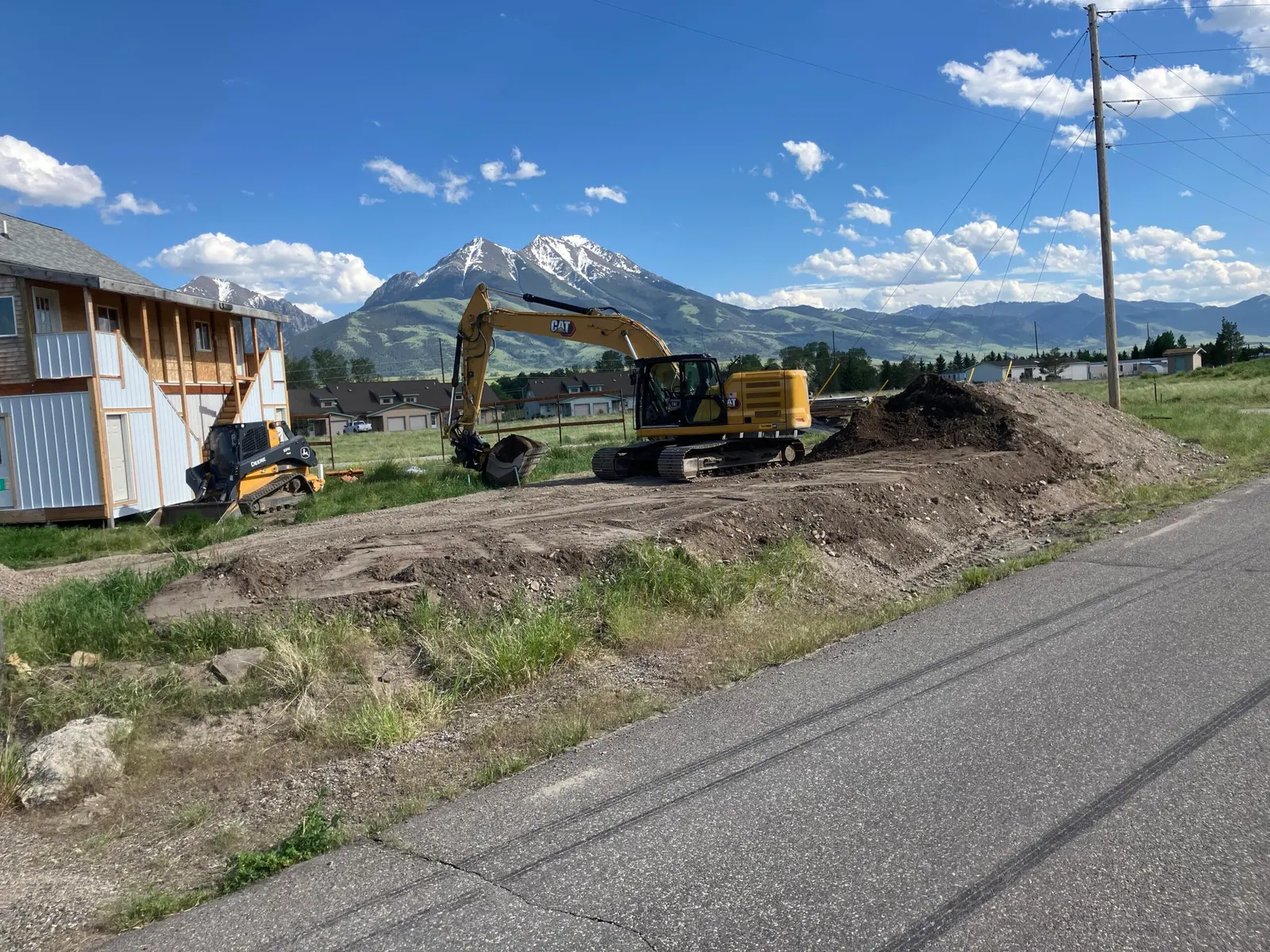
A parking lot is a road that never gets to rest — every square foot of it takes wheels, water, and winter.
Gravel Parking Lots & Pads in Paradise Valley, Montana
EZ Road Repair builds compacted gravel parking lots, equipment pads, and laydown yards for businesses, shops, churches, and ranches across Emigrant, Livingston, Pray, Chico, and Gardiner. Built right, gravel is a permanent commercial surface, not a placeholder — plenty of Montana shops, yards, and trailheads have run on it for decades. Built wrong, it’s a mud pit in April and a washboard by August. The difference is rarely the rock on top. It’s the base underneath, the fall across the surface, and whether water has anywhere to go once it reaches the edge.
When this matters
- A shop, store, or church needs real parking without asphalt cost
- An equipment yard or laydown area has to carry loaded trucks year round
- Overflow or event parking has to survive a wet weekend without being torn up
- RV, stock trailer, and truck parking where turning loads grind soft ground into ruts
- An existing lot has been bladed so many times there’s nothing left to blade
- Water stands in the middle of the lot after every rain and freezes there
A lot gets loaded differently than a driveway
A driveway carries a pickup a few times a day in two wheel tracks. A commercial lot takes repeated heavy loads, and it takes them in patterns. The entrance, drive aisle, and turnaround absorb nearly every axle, while stalls take static weight plus the occasional trailer jack punching a point load through the surface. A lot built to one uniform depth fails at the entrance first, so we build the base deeper where tires brake, accelerate, and turn under power.
Underneath all of it is the subgrade, and the subgrade decides the lot. Topsoil, sod, and soft clay have to come out: they hold water, they never compact, and anything built on them settles unevenly. Where native ground is fine-grained and wet, a separation fabric between subgrade and base keeps the two from mixing — without it, repeated loading pumps mud up into the aggregate and the base quietly disappears into the ground. Base goes in compacted in lifts, because a thick loose lift compacts only at the top.
Water on a big flat has to be given a direction
This is where most lots are lost. A driveway sheds sideways in ten or twelve feet. A lot can be 150 feet across, all of it shedding at once. Gravel surfaces generally want roughly 2 to 4 percent fall — enough that water leaves before it soaks in, not so much that loaded trailers feel it. Across a wide footprint that’s real elevation change, so the fall gets designed into the grading before the first load of rock shows up.
Then the water has to actually get off the property. A perfectly crowned lot ringed by a berm of grading spoil is just a bathtub with good intentions. The low side needs a ditch or swale holding roughly 1 to 2 percent grade to a real outlet, and where runoff crosses an approach it needs a correctly sized, properly bedded culvert. Edge containment matters too: an unconfined gravel edge ravels outward every time a tire clips it, and every plow pass throws more of it into the weeds.
Where this goes wrong
- Base sized for cars, loaded by trucks. Holds a season, then the entrance and drive aisle rut while the rest looks fine.
- A dead-flat lot. With no fall, the middle ponds, saturates the base from above, and becomes a pothole field.
- Spoil berms around the perimeter. Material windrowed at the edges traps everything the lot sheds.
- Too much loose surface rock. A deep, uncompacted top course floats under tires, washboards, and gives a plow something to peel.
- Blading a failed base. Once potholes go through to bad base, a blade only moves material around the holes — that’s the point to rebuild, not regrade.
- No snow plan. If the only place to push snow is the drainage side, the melt runs back across the lot and freezes.
Built to be plowed
A compacted, crowned lot is a lot a plow can work. The blade rides a tight surface instead of digging into loose rock, and meltwater drains off instead of glazing the footprint into a rink overnight. We run commercial plowing all winter, so we lay lots out the way a plow wants to find them, with pile locations on the high side.
How we approach it
We walk the lot first — what parks on it, where it drains now, where the snow will go, and how trucks will enter and turn. From there the sequence is consistent: strip organics and failed material, cut the subgrade to a shape that already drains, and stabilize soft areas rather than bridging over them. Base goes in compacted in lifts to the depth the traffic warrants, heavier at the entrance. The surface course is a compacted road mix with fines that bind, not clean rock that rolls, graded to shed. Ditches, swales, and culverts get cut on the same trip so the drainage leaves with the lot rather than becoming next spring’s callback. Where mud tracking onto a county road matters, we can build a tracking pad at the approach, and on a larger job the site prep runs with the same crew.
Serving Paradise Valley & Southwestern Montana
Based in Emigrant, we build lots and pads throughout Paradise Valley — Livingston, Pray, Chico, Gardiner — and for businesses and ranches across the surrounding country.
Get a gravel parking lot estimate
Call (406) 623-9075 or request a quote. Tell us the footprint, what parks on it, and what it does when it rains, and we’ll walk it with you and put together an estimate.
EZ Road Repair and Excavation — locally owned, Montana tough.