
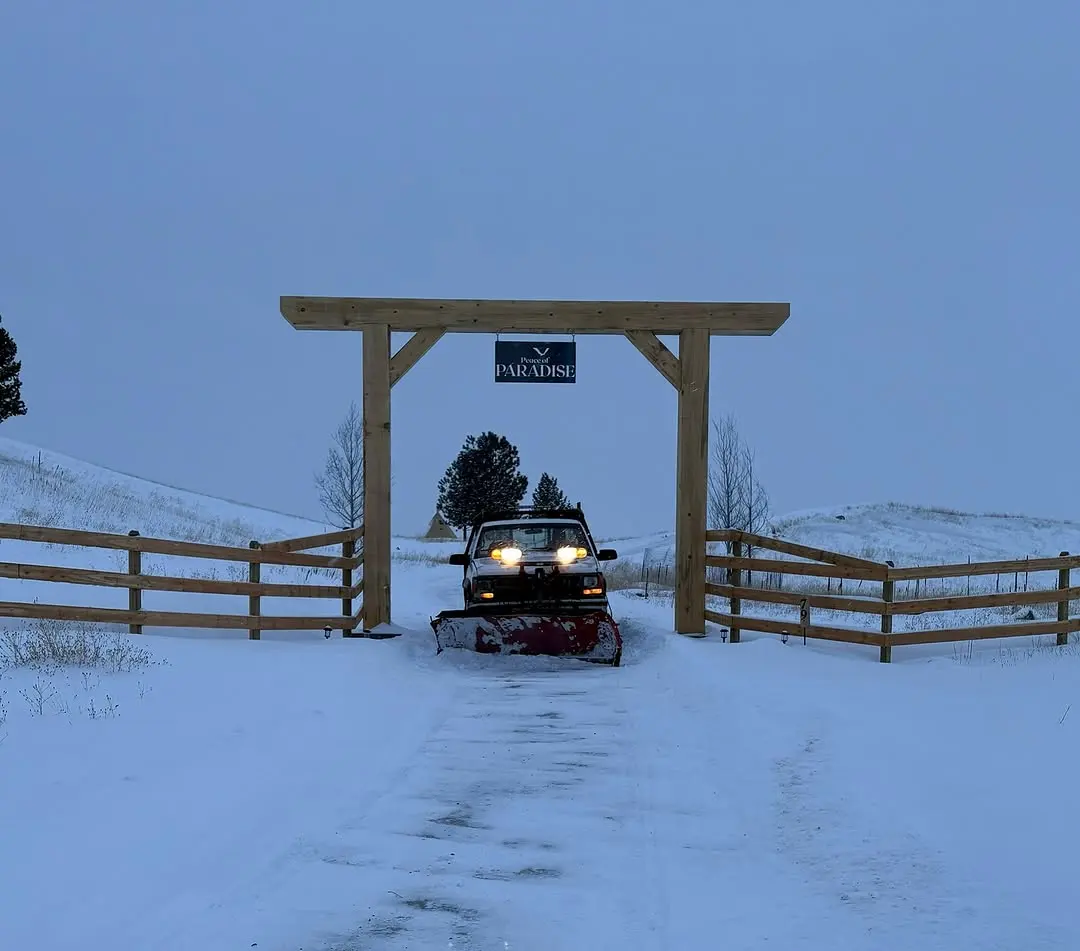
A commercial lot gets judged the moment your first customer pulls in.
Commercial Snow Removal & Plowing in Livingston and Paradise Valley, Montana
Livingston winter has a reputation for a reason: the snow comes sideways, and what fell out in the field ends up stacked against your building. EZ Road Repair is based in Emigrant and runs commercial winter service for businesses, ranches, and shared properties across Livingston, Pray, Chico, Emigrant, and Gardiner, with trucks, loaders, and dump trucks sized for lots and long approach roads rather than driveways.
Commercial plowing is a different job than a driveway. A lot has doors, docks, fire lanes, drive aisles, sightlines, and a clock. Pushing the snow is the easy part. Deciding where a whole winter’s worth of it will sit — and what that pile becomes once it melts and refreezes — determines whether the lot still works in February.
When this matters
- Customers and employees arrive before the plow does, and the lot is the first thing they judge
- Snow piles have crept into the corner stalls and you lose parking with every storm
- Someone slipped, or nearly did, on the same shaded strip by the entry
- Deliveries and dock access have to stay open regardless of what fell overnight
- Wind drifts the same gate or approach shut every time, even after a clean plow
- Ranch feeding, barns, and corrals have to stay reachable every day
- An HOA or shared private road needs one contractor accountable for the whole thing
Where the snow goes decides everything else
Snow placement is the first decision on a commercial property, and it belongs in a plan made before the season rather than in the middle of the first storm. Piles want to go where they cost the least: off the stalls nearest the door, out of the entrance sightline, clear of fire lanes and hydrants, and — the one most people miss — downhill of the pavement instead of uphill of it. A pile stacked above a lot drains across that lot every sunny afternoon and freezes it solid every night. A pile stacked on a storm inlet or across a drainage swale plugs the outlet at exactly the moment the melt shows up.
Height matters too. Once a pile stands taller than a windshield at a drive aisle, a routine exit becomes a blind pull-out, and another push only makes it worse. The answer is loading and hauling the piles off the property so the lot gets its capacity and visibility back.
Ice is the part that hurts
Plowing removes the snow. What’s left behind is the hazard. Traffic packs the last quarter inch into glaze, meltwater runs off the piles in the afternoon and locks up after dark, and roof and canopy drip lines build ice right where people step out of a vehicle. Businesses carry slip exposure a homeowner does not, and it concentrates in a few predictable places: entries, walk zones, accessible aisles, ramps, stair landings, and any slope in the drive approach.
Those are the areas we treat with sand and gravel traction, the practical approach for Montana lots. Chemical melters lose most of their bite as temperatures drop into the teens and below, and repeated salting shortens the life of concrete walks and aprons. Traction material works at any temperature because it isn’t trying to melt anything.
Where this goes wrong
- Snow stacked uphill of the pavement. Every thaw sends water back across the surface you just paid to clear.
- Piles set on inlets and swales. The lot drains fine all summer and floods the first warm week in March.
- Plowing to the same line all winter. Without deliberate pushback while the piles are still small, the usable lot shrinks a row at a time and can’t be recovered without a loader.
- Ignoring the drift pattern. Wind here loads snow into the lee of buildings, fence lines, and windrows. Clearing without accounting for the prevailing direction means plowing the same drift over and over.
- A lot that was already failing. Birdbaths, ruts, and flat spots ice in the same places every year, and a plow blade finds every broken edge and heaved seam.
- No decision about hours. Nobody agreed in advance whether the crew works around parked cars mid-morning or clears an empty lot ahead of staff.
How we approach it
We walk the property with you before the season: entrances and exits, the doors and docks that come first, fire lanes and hydrants, which direction the lot drains, where piles can sit without eating stalls, and what your operating hours actually demand. That becomes the plan for the property, run either as a seasonal contract or per event. Storm work follows the same sequence — plow, pushback while the piles are still manageable, then traction material where people walk and brake. When piles outgrow the site, we load and haul them off. When a storm runs past the plan, there’s emergency snow and ice response, and shared roads and subdivisions fall under our HOA and private road work.
The off-season half of the job matters as much. If your lot ices in the same three spots every winter, the real fix is drainage and surface repair, not more sand. Gravel lots and yards plow far better when they’re built and graded for it, and a crowned, well-drained approach road is cheaper to keep open than a flat, rutted one.
Serving Paradise Valley & Southwestern Montana
Based in Emigrant, we run commercial winter service in Livingston, throughout Paradise Valley — Pray, Chico, Gardiner — and for ranch operations across the surrounding country.
Get a commercial snow removal estimate
Call (406) 623-9075 or request a quote before the first storm. Tell us the property, your hours, and what can’t be blocked, and we’ll walk it with you and put together a plan and straight pricing.
EZ Road Repair and Excavation — locally owned, Montana tough.