
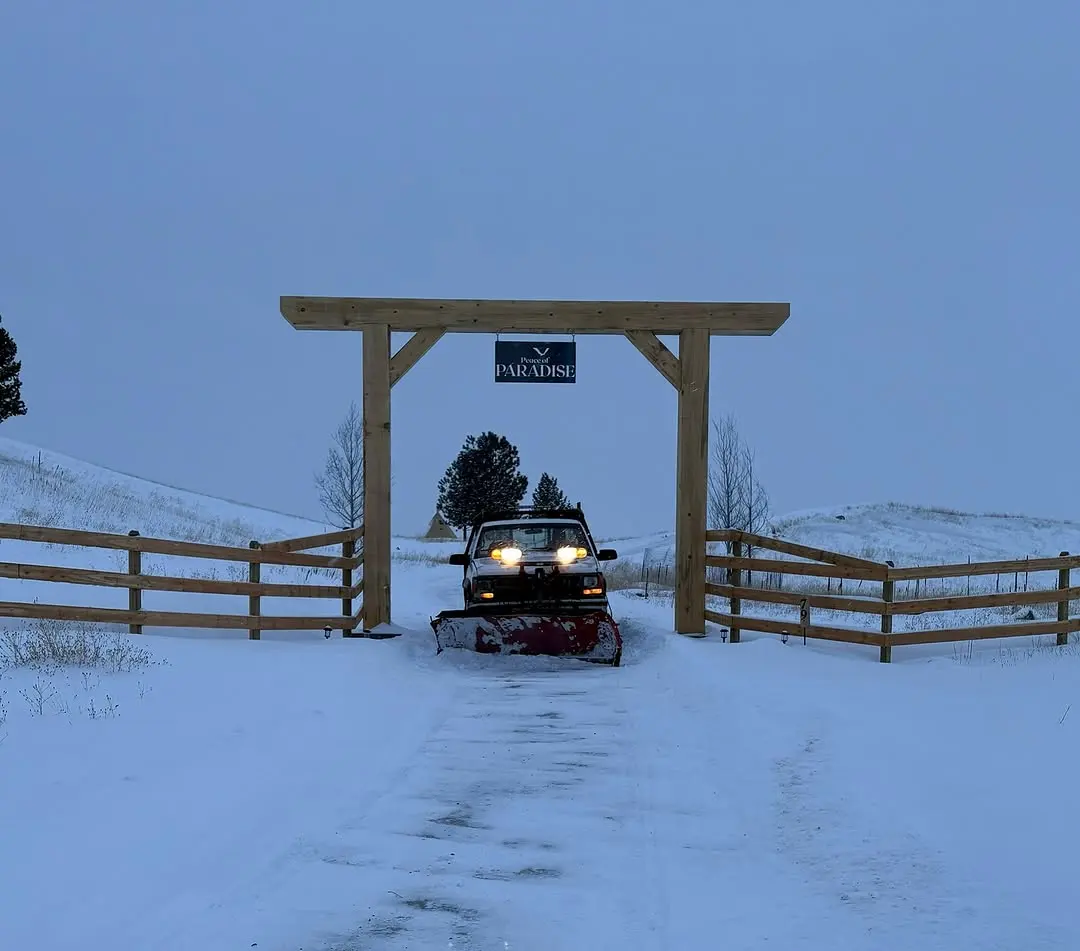
Plowing moves snow to the edge of the lot. Hauling is what you call when the edge of the lot is full.
Snow Hauling & Snow Pile Removal in Paradise Valley, Montana
Every plowed property has a snow storage budget, and almost nobody counts it until it runs out. By midwinter the corners of a lot in Livingston are stacked eight feet high, a ranch approach off East River Road has banks tall enough to hide a truck, and the pile at the end of a driveway in Pray is now a solid, gritty ice mound that a plow blade just bounces off. EZ Road Repair is based in Emigrant and loads that snow into dump trucks and takes it away — from commercial lots, HOA and subdivision roads, ranch yards, and homes from Gardiner to Chico to the north end of the valley.
When this matters
- A parking lot is losing stalls every storm because the banks keep eating into the pavement
- Piles at an entrance or approach block the view of oncoming traffic
- There is nowhere left to push, and the next storm has to go somewhere
- Snow is stacked uphill of a building, a door, or a driveway that will get the meltwater
- Stored snow has buried a fire lane, a dumpster pad, a propane fill, or a hydrant
- Banks along a shared road have narrowed it to one lane with no turnout
- A pile has frozen into a mound the plow truck can no longer climb or shave down
A pile is stored water, and it is heavier than it looks
Fresh snow is mostly air. Plowed snow is not. By the time a bank has been pushed, stacked, thawed at midday, and refrozen overnight a dozen times, it is dense, layered ice with sand, cinders, gravel, and whatever else came off the lot mixed through it — several hundred pounds per cubic yard, and stubborn enough that loading it is a machine job, not a shovel job.
That density is also why the melt hits so hard. A winter’s worth of snowfall stacked into one corner releases over a few warm days in March, in one place, on one path. If that path runs toward a building, a garage apron, or a low spot in the lot, you get standing water by afternoon and a sheet of ice by morning. The same lot can be dry all summer and flood every spring for exactly this reason — nothing is wrong with the pavement, the water is just being concentrated by where the snow got put.
Freeze-thaw does the rest. Water working under asphalt or into a gravel surface, freezing, and lifting is what turns a good lot into a broken one, and a pile parked in the same spot every winter is a reliable way to feed it.
Where snow storage goes wrong
- Piles at the sightline. Snow stacked at a driveway approach or an intersection hides oncoming traffic. On the highway corridor and the county roads, that is the pile that has to move first.
- Piling uphill of the building. The bank looks harmless in January and drains straight to the foundation, the crawlspace vent, or the overhead door in March.
- Piling on top of the drainage. Snow stacked over a swale, ditch, culvert inlet, or drain grate plugs the outlet at the exact moment there is water to carry, so the melt backs up instead of leaving.
- Piling on things you will want back. Curbs, landscaping, irrigation heads, and septic drain fields all take damage under stacked and compacted snow, and packed snow over a drain field drives frost deeper instead of insulating it.
- Waiting until it is frozen solid. A pile hauled while it is still workable loads fast; the same pile after three thaw cycles has to be broken up first.
- Dumping into a watercourse. Plowed snow carries sand, grit, and road oil. Ditches feeding creeks and the Yellowstone are not a snow dump, and picking a spot that drains through soil instead of into a channel is part of the job.
How we approach it
We look at the piles and the access first: how much snow is actually there, what it has frozen into, where trucks can stage, and whether the approach or a culvert crossing will take loaded weight. From there, a loader or skid steer breaks the banks down and loads dump trucks, and the snow goes off-site to an appropriate dump location or to a low-impact spot on your own ground — chosen so the meltwater soaks in and drains away from anything, not across your entrance. On commercial lots we usually work outside business hours so the stalls come back before customers do.
Once the piles are gone, the pavement or gravel surface that comes back out from under them is often glazed and needs sand or cinders for traction. Where the same corner floods every spring, the real fix is usually drainage rather than another haul, and where the melt has already cut ruts and washed material out, that is spring runoff repair. Properties that run out of room every year do better folding hauling into the seasonal plan alongside regular plowing, so storage never gets to the breaking point. One-time hauls are just as welcome, and when a storm has you buried right now there is emergency snow and ice response.
Serving Paradise Valley & Southwestern Montana
Based in Emigrant, we haul snow throughout Paradise Valley — Livingston, Pray, Chico, Gardiner — for businesses, ranches, HOAs, and homeowners with more snow than space.
Get a snow hauling estimate
Call (406) 623-9075 or request a quote. Tell us how big the piles are, what they are blocking, and how trucks can get in, and we will size the loader and the trucks to the job.
EZ Road Repair and Excavation — locally owned, Montana tough.