
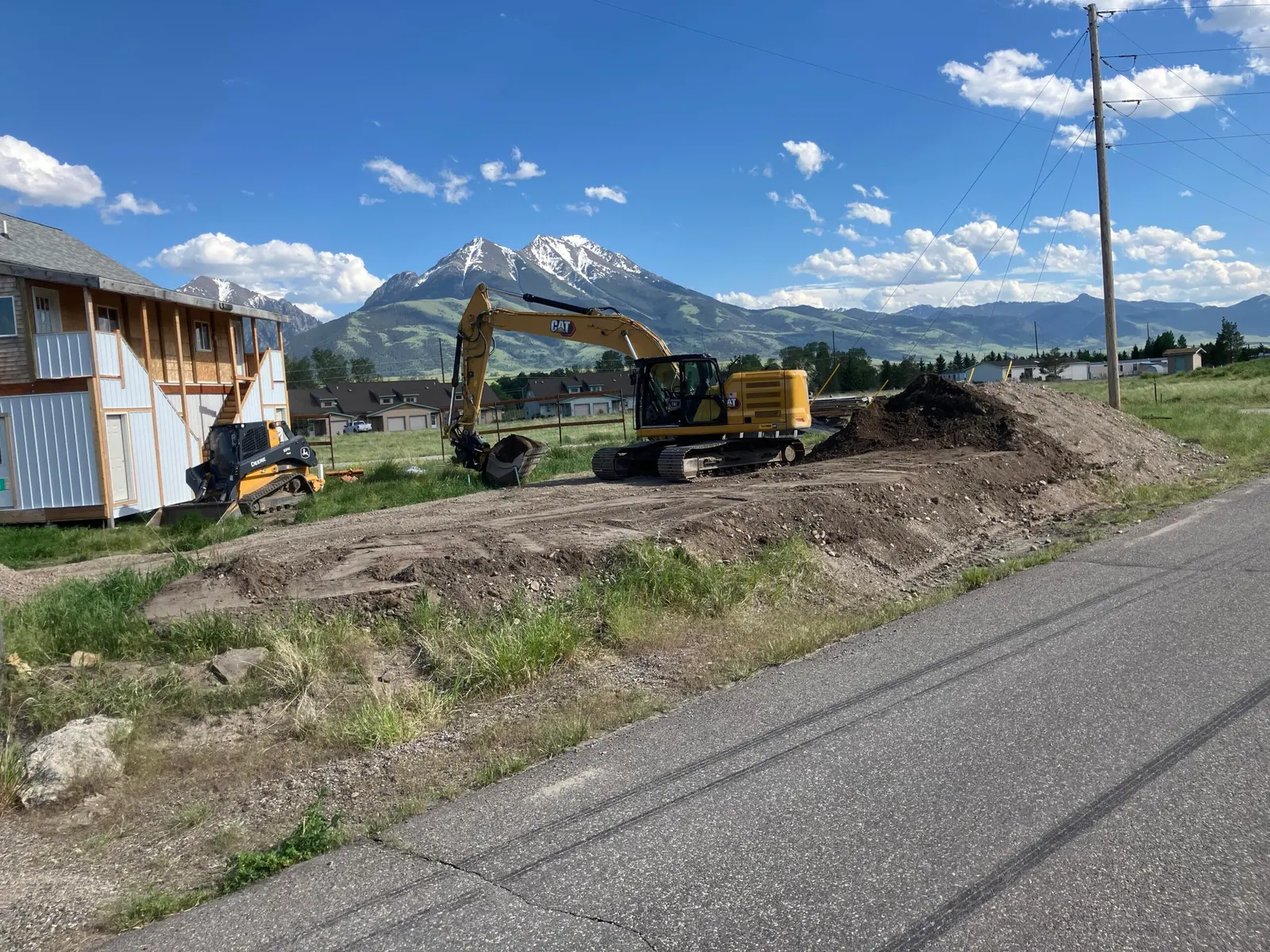
A road that lasts out here is won underground.
Road Building in Paradise Valley, Montana
EZ Road Repair builds new driveways, access roads, and ranch roads from raw ground across Emigrant, Livingston, Pray, Gardiner, Chico, and the rest of Paradise Valley. New construction is a different job than fixing a road that has already failed — if yours ruts or washes out every spring, that is road repair and rebuilding work. This is about cutting a road in where there wasn’t one: clearing the route, shaping it to grade, routing the water before the first load of gravel shows up, and compacting a base that will still be under you in ten winters.
When this matters
- You bought raw land and need real, drivable access from the county road to a building site
- The two-track you’ve been using turns to soup in April and won’t carry a loaded truck
- A new house, shop, or barn needs an approach concrete trucks and lumber deliveries can use
- Pasture, hay ground, or a back gate needs an all-weather route — see ranch roads
- A shared or subdivision road has to serve several properties and take everyone’s traffic
What actually holds a road up
A finished road is four things stacked: subgrade, base, surface, and the drainage that keeps all three dry. Nearly all of the durability lives in the bottom two — exactly where corners get cut, because nobody sees them again.
The subgrade is native ground, and it decides everything above it. Where we hit topsoil, peat, or fat clay, that material comes out — organic soil rots and compresses, and clay pumps water up into the base every spring. Soft spots get over-excavated and bridged with coarser rock, or separated with fabric so the good rock doesn’t disappear into the mud.
Base goes in lifts, not one deep dump: shallow layers, moisture-conditioned, each one rolled until it stops moving under the drum before the next goes on. A thick base placed loose is weaker than a thinner base placed tight — a road carries load by arching it across locked-together aggregate, and stones only lock when they’re compacted at the right moisture.
The surface is the last layer to worry about. For most rural drives and ranch roads here it’s road mix — a graded blend with enough fines to bind and shed water instead of rolling out from under tires the way clean crushed rock does.
Drainage gets designed before the gravel
Water is what takes roads apart in Park County, and on a new build you get one clean chance to decide where it goes.
That means a crown: the centerline sitting roughly two to four percent above the edges so rain and snowmelt run off the surface rather than soak down through it. It means ditches with real fall — generally in the one to two percent range — cut deep enough to drain the base, not just to decorate the shoulder. And it means culverts sized for the water that shows up in a heavy runoff year, not the trickle in the draw in August — set on grade, bedded, and covered deep enough that a loaded truck doesn’t collapse them.
Cross-drainage on a grade is the part that gets skipped. On a road climbing a bench, water that finds a wheel rut runs downhill picking up speed and material until the road becomes the creek. Relief culverts or water bars dump that flow off before it can build, and a hard outfall gets armored with rock.
What Montana conditions do to a new road
Freeze-thaw is the hard one. Water trapped in a base freezes and lifts the road; in spring the top thaws while the ground below is still frozen, the meltwater has nowhere to go, and the base turns soft under traffic. That is frost-boil season, and it is why a road on clean, free-draining rock survives March while a road on silty fill comes apart. Utilities crossing the road get set below frost depth for the same reason.
Ground here cuts both ways. Much of the valley is glacial cobble and river rock, which drains beautifully and makes an excellent subgrade, but it also means rippers and rock buckets to reach grade. Steep, remote sites add their own limits: a grade a loaded truck can climb and still stop coming down, benched cuts on side hills so the fill half doesn’t slough away, and turnarounds wide enough for a fire truck.
The season is short. Base can’t be compacted properly frozen or saturated, and the ground can stay locked up from November into April, so planning a spring road the fall before puts you well ahead.
How we approach it
We walk the route with you first: where the water comes from, and what has to drive on it. From there the sequence is straightforward: clear and grub the corridor and strip organics off the alignment; cut and fill to a grade that suits the vehicles you run, balancing dirt on site where we can; shape ditches and set culverts as part of the drainage plan rather than an afterthought; trench any water, power, or communication lines under the road bed before base goes down; build the base in compacted lifts; then crown, surface, and roll it. Where the road ties into a county road, we build the approach so the transition isn’t the weak point. Once it’s finished, we can pick it up on a maintenance schedule so it keeps its crown instead of quietly losing it.
Serving Paradise Valley & Southwestern Montana
Based in Emigrant, we build roads and driveways throughout Paradise Valley — Livingston, Pray, Gardiner, Chico — and the surrounding ranch and mountain properties.
Get a road building estimate
Call (406) 623-9075 or request a quote. Tell us where the road needs to go, what has to drive on it, and what the ground does when it’s wet, and we’ll look at the site and give you a straight estimate.
EZ Road Repair and Excavation — locally owned, Montana tough.