
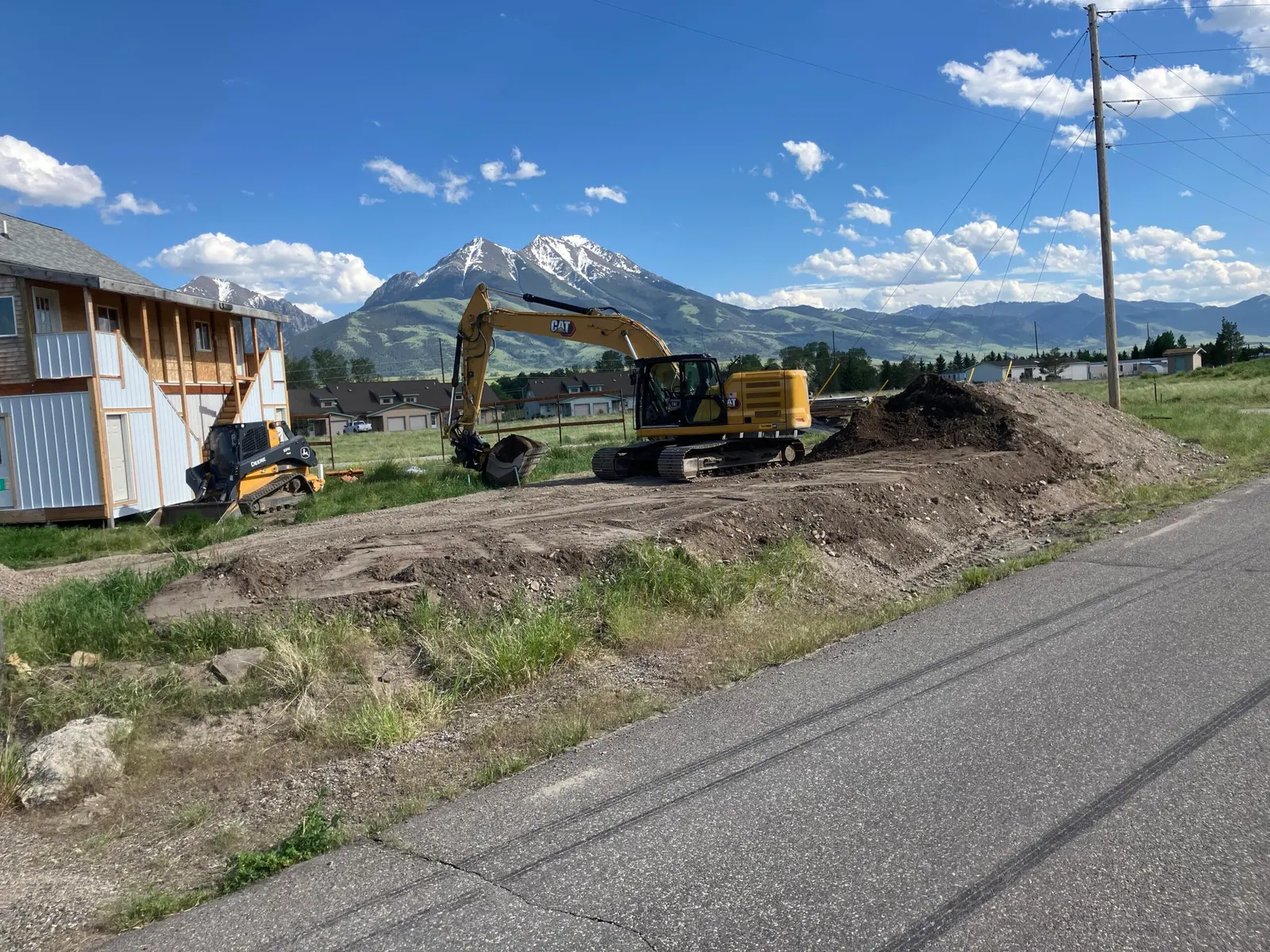
On a working place the road is equipment — it feeds stock in January and hauls every ton of hay you put up.
Ranch Road Construction & Maintenance in Paradise Valley, Montana
EZ Road Repair builds and maintains private ranch and agricultural roads across Paradise Valley and Park County — Emigrant, Pray, Chico, Livingston, Gardiner, and the drainages behind them. A ranch road is not a driveway that got long. It carries loaded stock trailers, feed trucks, tractors and balers, and the occasional semi over miles of ground no county crew will ever touch. And it doesn’t fail politely — it fails at the one crossing between the calving shed and the highway, in the two weeks of the year you can least afford it.
When this matters
- A feed route that goes soft every spring and drifts shut every winter
- Miles of two-track that need to become an all-weather road
- New access to a barn, shop, corrals, a well, or a far pasture
- A creek, ditch, or draw crossing that washes out and cuts the place in half
- A road that eats a blade every season because nothing was built underneath it
- Turns a stock trailer can’t make without dropping a wheel off the edge
What a ranch road actually has to carry
Design starts with the heaviest thing that uses the road, not the average thing. A gooseneck of cattle or a loaded feed truck puts far more on the subgrade than a pickup, and puts it there in a narrow wheel path that pumps and ruts wherever the base is thin. That means real running width plus shoulder — a trailer tracking inside the truck’s line should still be on built ground — and turn radii sized for the longest rig that comes in.
The details that make a ranch road usable never show up on a plan. A cattle guard needs level, compacted, drained approaches on both sides, or the road pumps out at the wings and the guard ends up sitting proud of the grade with a step at each end. A gate needs a flat spot wide enough to stop and swing it without the truck creeping backward. Pull-outs on a single-lane road let a hay truck and a feed pickup pass without one backing a quarter mile.
What Montana does to it
Freeze-thaw is the engine behind most ranch road failure. Water held in the base freezes, lifts the surface, and leaves a soft void when it goes out. That’s where spring breakup and frost boils come from: a road that carried a loaded truck in February turns to pudding for three weeks in April, in exactly the spots that hold water. The fix is almost never more gravel on top. It’s getting water out of the road and away from it — a crown of roughly two to four percent so the surface sheds, ditches cut at a workable grade with somewhere to go, and relief culverts on long pitches so a ditch doesn’t gather a half mile of runoff and dump it in one place.
Runoff off the Absarokas moves hard and briefly, and irrigation puts a second season of water on otherwise dry ground — a road crossing a working ditch gets built around the ditch’s schedule, not the road’s. Then there’s drifting. A road cut below grade, or run along the lee of a fence line or shelterbelt, loads with snow all winter no matter how often it’s plowed. An alignment sitting slightly proud of the ground around it stays open with far less work.
Where this goes wrong
- Gravel over mud. Road mix spread on a soft, uncompacted subgrade disappears into it. The base gets built first, in compacted lifts, or the surface becomes an annual expense.
- A ditch with no outlet. Water that can’t leave the road runs down it, and a road carrying water becomes a creek bed.
- Undersized or silted culverts. A pipe too small, set above the flow line, or plugged with silt and willow is the same as no pipe on the day it counts.
- Blading the crown off. A blade run without a plan flattens the crown and berms the shoulder, trapping water on the running surface.
- Grades chosen for a pickup. A pitch a pickup climbs easily will spin a loaded feed truck in February and scour hard in June.
- Nothing planned for the plow. Rock berms, hidden edges, and no place to put snow make a road expensive all winter.
How we approach it
We drive the road with you first — the failure points are obvious to anyone who’s been stuck in them. Then we work out where the water comes from and where it can go, and build in that order. Brush and fence lines crowding the road get cleared back so it can be seen, plowed, and dried by sun and wind. Crossings get properly sized culverts set at the flow line and armored at inlet and outlet. Ditches and swales get cut with grade and a real outlet rather than a place to pond. Soft sections are excavated and rebuilt from the subgrade up in the same road building order we use anywhere — drainage, base, surface — topped with compacted road mix at a depth that matches the loads. After that it’s upkeep on the ranch calendar: grading and re-crowning after runoff, gravel where it’s thinning, culverts cleaned before freeze-up, and plowing on a road built the way a plow wants it.
Serving Paradise Valley & Southwestern Montana
Based in Emigrant, we work ranches throughout Paradise Valley and Park County — Livingston, Pray, Chico, Gardiner, Tom Miner — and take projects toward Big Timber and the Shields.
Get a ranch road estimate
Call (406) 623-9075 or request a quote. Tell us what the road carries, where it fails, and how many miles you’re fighting, and we’ll drive it with you and lay out a straight plan.
EZ Road Repair and Excavation — locally owned, Montana tough.