
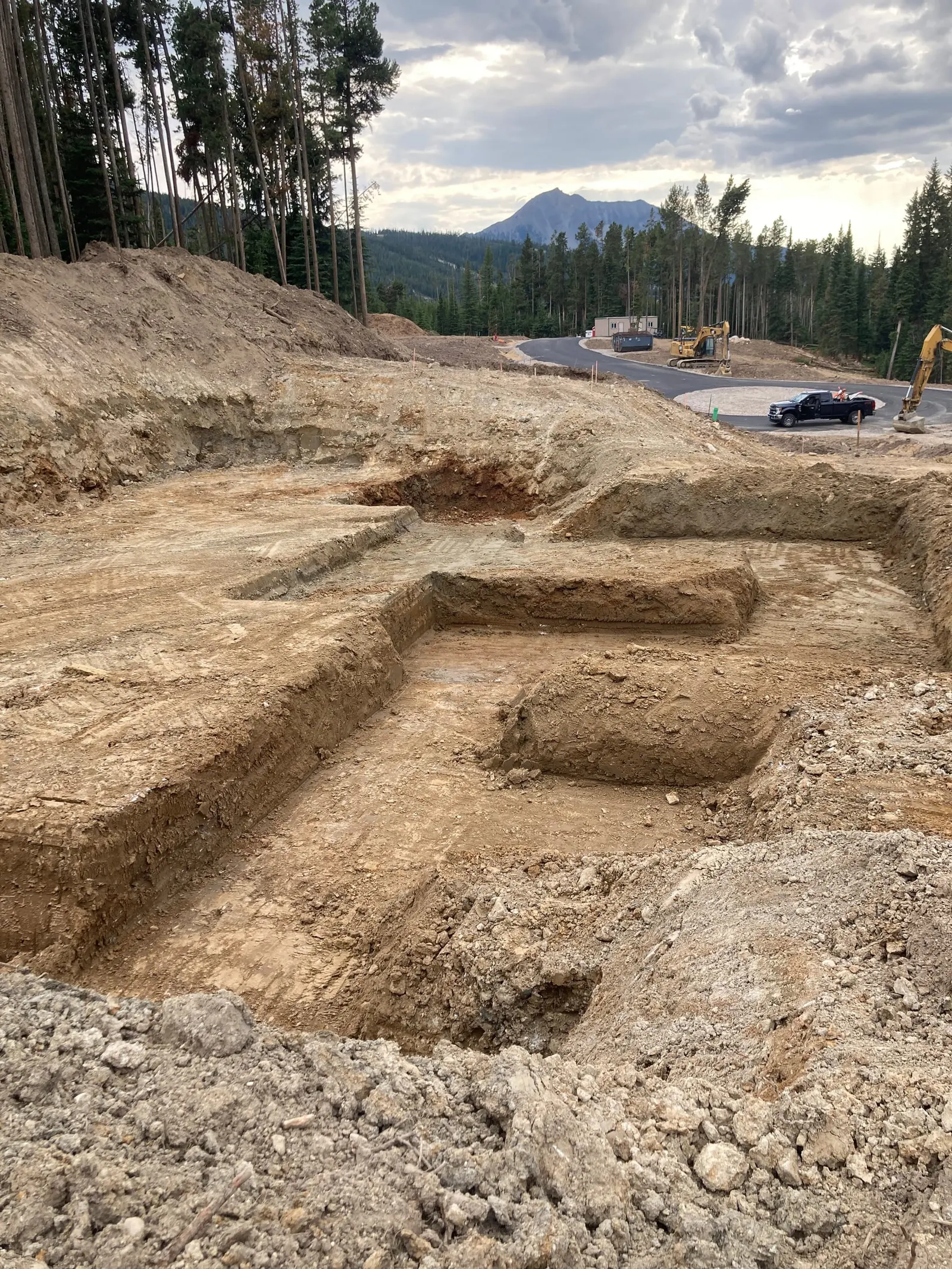
A building is only as good as the ground somebody put under it.
Pad Building & House Pad Construction in Paradise Valley, Montana
EZ Road Repair builds compacted house pads, shop pads, barn pads, and equipment pads across Emigrant, Livingston, Pray, Chico, Gardiner, and the length of Paradise Valley. A pad is not a flat spot. It is a built platform — organics stripped off, structural fill placed in thin lifts, every lift compacted, and the finished surface shaped so water leaves. Get it wrong and the mistake shows up two winters later as a cracked slab, a door that quits latching, or one corner of a shop that has quietly dropped an inch.
When this matters
- A new home or cabin that needs a level, load-bearing platform for the foundation
- Shops, garages, barns, and machine sheds going onto gravel-finished pads
- A sloped building site that needs a cut-and-fill bench keyed into firm ground
- Soft, wet, or organic soil where a slab would settle unevenly
- An ag or equipment pad that has to carry loaded trucks and a tractor year round
- Ranch buildings that need all-weather pads plus access that holds up
Pad building is not lot leveling
The two get used interchangeably and they are different jobs. Lot leveling is about the parcel: reshaping rolling or awkward ground into usable, drainable land — a yard, a building envelope, a place to park equipment. Pad building is about the footprint the structure sits on, and it is structural work with a compaction standard behind it. Plenty of sites need both, in that order, and the difference between the two is worth understanding before you sign anything. A bladed, level lot is not a pad, no matter how good it looks with a string line across it.
How a pad is actually built
Topsoil comes off first and gets stockpiled for final grading. It is organic — it decomposes and compresses under load, so anything built on it sits on material that is still changing. The exposed subgrade then gets proof rolled: we run a loaded truck or heavy machine across it and watch. Ground that pumps, ruts, or deflects will do the same under a building, and it gets dug out and replaced rather than covered up.
Then the pad goes up in lifts — thin layers of structural fill, typically six to eight inches loose, compacted before the next one goes on. Lift thickness is not arbitrary. A roller only densifies so deep, so material dumped two feet at a time gets compacted on top and stays loose underneath, which is exactly where later settlement comes from. Moisture matters as much as passes: fill that is bone dry won’t knit together, and fill that is too wet pumps instead of compacting. On engineered jobs the spec names material, lift thickness, and density; without a formal spec we build to the same discipline, because compaction is what makes or breaks a pad.
Material choice is part of it. Free-draining granular fill holds load and sheds water; silty, frost-susceptible material holds water, freezes, heaves, and leaves a void behind when it thaws — the mechanism behind most Montana slab and footing failures. We can haul in the right material rather than making do with whatever came out of the cut.
On a slope — which is most of this valley — the fill side has to be benched. Cutting steps into the existing hillside gives new fill something to key into instead of a smooth surface it can slide along. The pad also gets built wider than the building line, because the outer edge of a fill slope is the least compacted part of it.
Where this goes wrong
- Bladed flat, never compacted. It reads dead level on day one and settles for years. Compaction is invisible on the finished surface, which is why it gets skipped.
- Built on topsoil or over buried stumps. Organics rot and compress. Anything that came off during land clearing belongs off the pad, not buried in it.
- Fill dumped on an unbenched slope. Without a keyed bench, the downhill side creeps and the building goes with it.
- Pad at or below surrounding grade. It should sit high with ground falling away from it. A pad in a bowl collects every bit of runoff the site produces.
- No plan for uphill water. Snowmelt off the benches finds the cut behind the building. It gets intercepted with a swale, ditch, or drain before it reaches the pad.
- Utilities trenched in afterward. Cutting lines through a finished pad undoes the compaction you paid for. Trench routes get set before the pad goes up.
How we approach it
We walk the site and look at soil, slope, access, where water enters and leaves, and what is going on the pad. Clearing and site prep come first, then topsoil strip and stockpile, then subgrade and proof roll. Utility routes get planned and trenched before fill goes down. The pad is built in compacted lifts to finished elevation, benched into the slope where the site calls for it, and carried past the building line. House pads are left at the grade the foundation crew needs; shop, barn, and ag pads are usually topped with compacted gravel and put straight to work. Before we leave, the drainage is set — positive fall away from the structure, with ditches, swales, or culverts wherever the site sends water.
Serving Paradise Valley & Southwestern Montana
Based in Emigrant, we build pads throughout Paradise Valley — Livingston, Pray, Gardiner, Chico — and take on pad and site work toward Bozeman and Big Timber ranch country.
Get a pad building estimate
Call (406) 623-9075 or request a quote. Tell us what’s going on the pad, the rough footprint, whether you have an engineer’s spec, and what the ground looks like now, and we’ll walk the site and put together a straight estimate.
EZ Road Repair and Excavation — locally owned, Montana tough.