
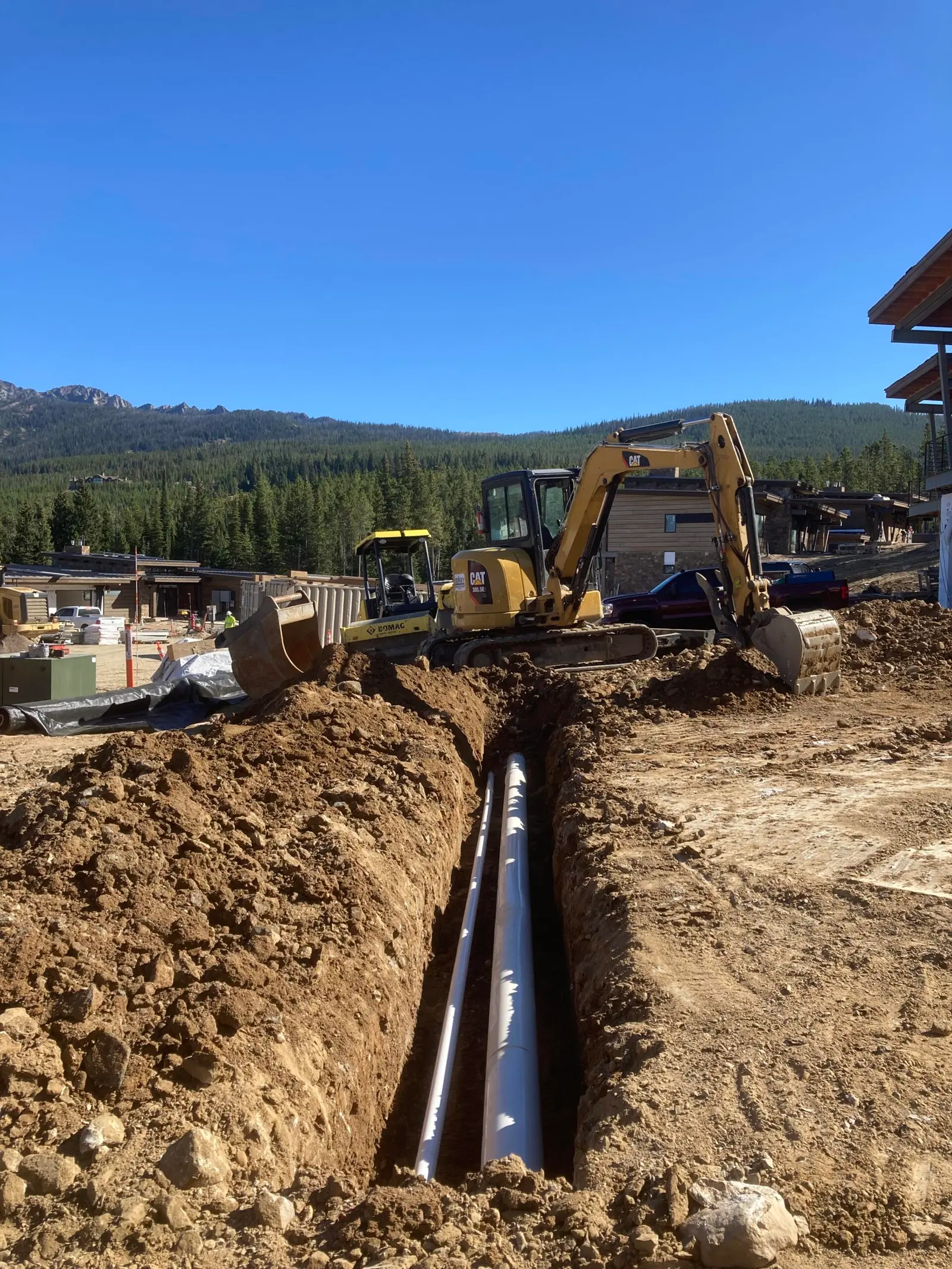
Lifelines in the ground at the right depth — and a trench that never shows again.
Utility Trenching in Paradise Valley, Montana
Every rural build needs its lifelines buried: water, power, sewer, and communications, each at the depth its own code calls for, bedded so it isn’t resting on rock, and closed up so the trench line disappears instead of settling for ten years. EZ Road Repair trenches utilities across Emigrant, Livingston, Pray, Gardiner, and Chico, working alongside your electrician, plumber, and the utility companies so the earth side is never what holds the project up.
Out here the runs are long, and the difference between a trench dug carefully and one dug fast shows up the first winter — a frozen service line, a sunken stripe across the new driveway, or water tracking down loose backfill to the foundation.
When this matters
- New builds bringing water and power from the road to the homesite
- Water lines that must sit below frost depth to survive January
- Sewer runs to the septic system at true, steady grade
- Power, gas, and comm conduit to shops, barns, and outbuildings
- Old direct-buried lines failing and needing to be dug up and re-laid
- A hydrant, frost-free spigot, or stock tank line well away from the house
Depth is set by the utility, not by convenience
There is no single trench depth. Water is the one everybody remembers, because a service line has to sit below frost depth with margin to spare — deeper here than the four feet that satisfies milder country, with the governing number coming from local code and the water system itself. Trench it shallow and it won’t fail in a mild year; it fails in the cold snap, under a driveway you just paid to build.
Gravity sewer is a different problem: not depth, fall. A gravity line wants steady, uninterrupted grade — commonly around a quarter inch per foot on a four-inch line — with no bellies and no reverse pitch, which means the trench bottom gets shot and trimmed, not eyeballed. One low spot holds solids and becomes a recurring service call.
Electric and comm carry their own cover requirements, and direct-buried cable generally wants more cover than the same circuit in conduit. Where several utilities share one corridor, separation matters as much as depth — so we set the profile around the deepest, most demanding line and stack the rest above it.
Bedding and backfill are the part nobody sees
The pipe is the cheap part; what protects it is what sits against it. Native spoil here is full of cobble, and a fist-sized rock bearing on plastic pipe is a point load that finds the wall eventually — often years later, under a lawn or driveway, where finding the leak costs more than the trench did.
So the run gets bedded on clean material, haunched along both sides so the pipe is supported all the way around, not bridging voids, and covered before native backfill goes in. Tracer wire goes with non-metallic water line so it can be found later, and warning tape above it so the next person with a bucket gets a warning first.
Then the trench is backfilled in compacted lifts, not pushed in and driven over once. That is the step that gets skipped, and the one that shows: loose backfill consolidates over the first few freeze-thaw cycles and leaves a sunken stripe across the yard or driveway. Worse, an uncompacted trench behaves like a french drain — surface water finds the loose column, runs it downhill, and delivers it wherever the trench ends, often a crawlspace or basement wall. Same principle as why compaction makes or breaks a driveway, pad, or road.
Rock is the variable
Estimating trench work here means estimating ground you can’t fully see. Alluvial benches near the Yellowstone are cobble and river rock; glacial till elsewhere hides boulders no trencher will cut; and on some sites bedrock comes up shallow and the plan changes to a hammer, a rock bucket, and a slower day. Rock costs more than digging time, too — when the spoil is too coarse to put back against pipe, bedding and select backfill get hauled in.
So we walk the route first, read the existing cuts and ditches on the property as evidence, and route around the worst of it where the plan allows. Better to say up front that a stretch looks like rock than surprise you halfway across it.
How we approach it
Locates come first — the one-call ticket goes in before any bucket moves, and marked ground gets treated as marked ground. Private lines are the catch on rural property: septic laterals, well lines, propane, irrigation, and old direct-buried runs generally aren’t covered by public locates, so we walk the site with you where records are thin. From there it’s route and grade, trench to depth, bed and haunch the run, set conduit where the plan calls for it, and backfill in compacted lifts, graded to shed water rather than pond over the line.
Trenching is cheapest while the site is already open. If we’re handling your excavation, site prep, foundation work, or the driveway, we sequence utility runs into the same mobilization and tie the surface back in with grading. Where a run crosses a ditch or culvert, we coordinate it with the drainage work instead of trenching a crossing twice — and because the season here is short, we’d rather plan the dig for workable ground than fight frozen backfill in December.
Serving Paradise Valley & Southwestern Montana
Based in Emigrant, we trench throughout Paradise Valley — Livingston, Pray, Gardiner, Chico — and the surrounding country where runs are long, ground is rocky, and frost is serious.
Get a trenching estimate
Call (406) 623-9075 or request a quote. Tell us what’s being run, how far, and what the ground is like along the route, and we’ll give you a straight estimate and coordinate with your trades.
EZ Road Repair and Excavation — locally owned, Montana tough.