
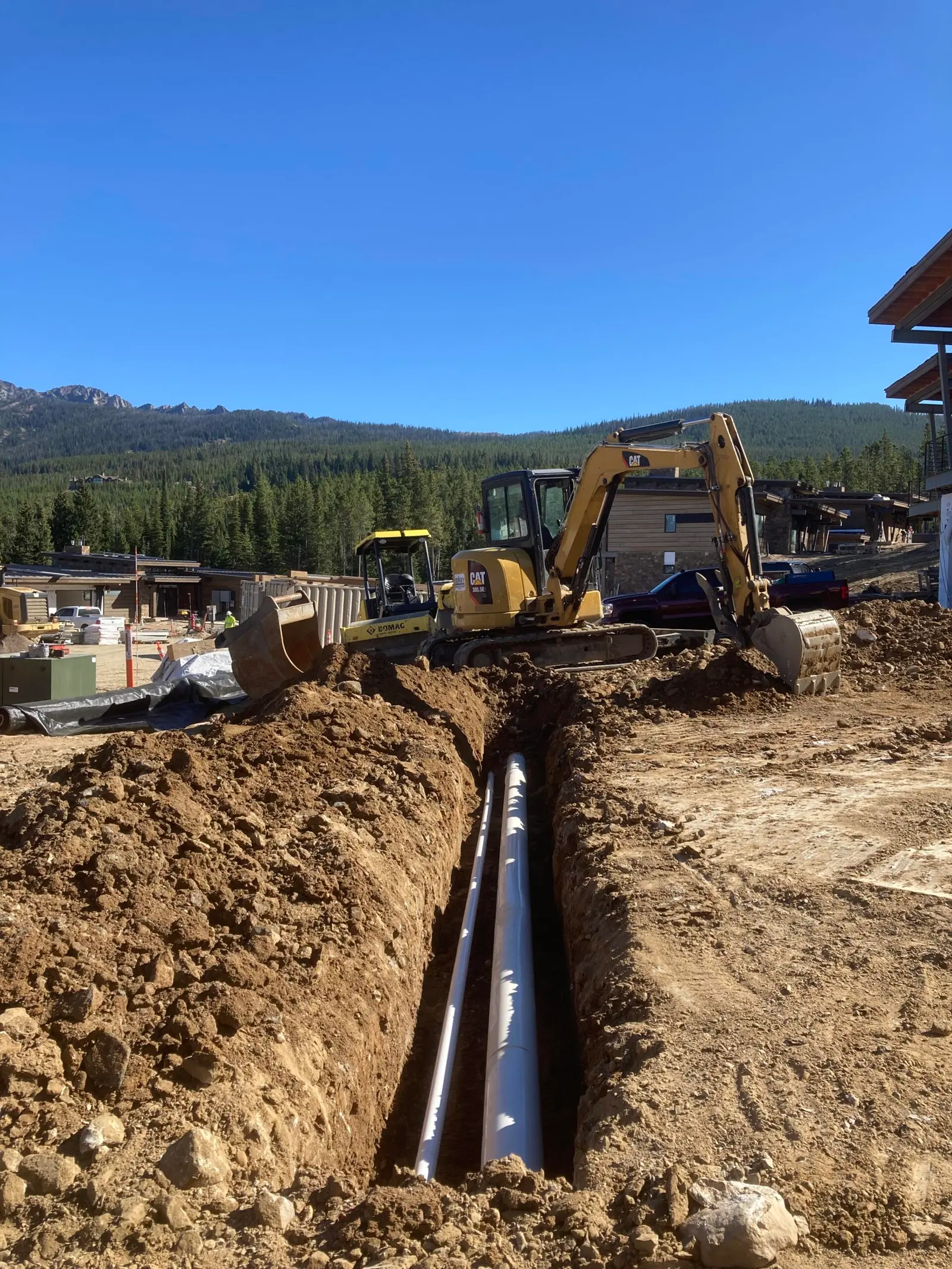
Built to the approved design. Backfilled like it has to last thirty years.
Septic System Installation in Paradise Valley, Montana
Out here your septic system is your wastewater treatment plant, and it lives or dies by the soil it sits in and the care it is built with. EZ Road Repair installs and replaces septic systems in Emigrant, Livingston, Pray, Chico, and Gardiner: tanks set on prepared bedding, drain field trenches cut to true grade, ground restored afterward.
Two things to be straight about up front. First, septic is Park County only. We do not install septic in Gallatin County or the Bozeman area — our excavation and earthwork travels further, but septic stays inside Park County. Second, we install; we do not design or permit. The soil evaluation, system design, and county permit come from a licensed designer or engineer. We build exactly what that approved design calls for, and we speak up when the drawing does not match what the ground is doing.
When this matters
- A new home, cabin, or guest house that needs its first system
- Slow drains through the whole house — not one fixture — plus gurgling plumbing
- Ground over the field that stays soggy, or grass suspiciously green and lush in August
- Backups that get noticeably worse during spring runoff
- A soft depression over the tank or a cracked lid — a safety hazard, not a nuisance
- A remodel or addition that changes bedroom count, and what the system must handle
- Lines crushed by traffic or found by tree roots
The soil decides everything, and it changes fast here
A septic system has two working halves. The tank separates solids and holds wastewater long enough to settle. The drain field spreads the liquid leaving the tank through perforated pipe into the soil, and the soil does the actual treatment as water moves toward groundwater. That second half is entirely at the mercy of the dirt.
Paradise Valley soils change over remarkably short distances. River bench ground can be coarse, open gravel that drains so fast the effluent never gets treated on the way down. Two hundred feet toward the toe of the slope you can hit tight glacial clay that barely accepts water, shallow bedrock, or seasonal groundwater sitting high in spring. All of those push the design past a simple buried trench field toward a sand-lined or mound system with imported media meeting spec: more area, more hauling, a longer build.
Which is why the drain field, not the house, should set the site plan. The field needs the right soil, enough usable area, and required separation from the well, surface water, property lines, and any steep cut face. On some lots exactly one spot satisfies all of that, so do the soil work before the pad and driveway are staked — our rural homeowner’s primer covers that sequence.
What Montana conditions do to a system
Frost. Tank lids, inlet and outlet pipe, and the building sewer need adequate cover, or insulation where cover is not available. A shallow line under a plowed driveway freezes.
Spring runoff. A field in the path of sheet flow off a hillside gets saturated exactly when it is already working hardest. That is a drainage problem, not a septic problem, solved with ditching, swales, and culverts that carry the water past the field instead of through it.
Slope and access. Steep ground limits trench layout and may call for stepped trenches or serial distribution. It also means the truck hauling the tank has to physically reach the hole, and imported media means repeated trips over whatever approach exists.
A short season. Soil testing generally is not valid on frozen ground, and frozen material will not compact cleanly. Most systems here go in between snowmelt and freeze-up, which makes winter the time for design and permit work, not digging.
How systems get shortened
The most common killer is compaction. Driving or parking over the field closes the soil pores the system depends on and crushes shallow pipe — usually because nobody marked the field before the gravel got extended. Close behind: trenching wet clay so the sidewalls smear and glaze, sealing the surface meant to absorb; skipping the barrier so soil migrates into the rock and blinds it; drains routed toward the field; and a final grade that ponds water on it.
How we approach it
We walk the site with the approved design in hand, locate and protect the well and buried utilities, and confirm the field area has not been driven on or stockpiled over. Topsoil is stripped and stockpiled separately. The tank hole is dug and the tank set on prepared bedding so it cannot settle or tip, then the building sewer is run at consistent grade. Field trenches are cut level or on the designed slope, bottoms left open and uncompacted; rock is placed, pipe set and checked, the barrier goes on, and backfill goes over without crushing pipe or sealing the field. Then we finish grade to shed surface water — the drain field installation in our gallery shows the trenching stage.
Since the machines are already there, this is the moment to pair septic with utility trenching so a line does not end up crossing the field later, or with foundation work on one mobilization. When we are done we reclaim the disturbed ground — backfill, regrade, respread topsoil — so the yard heals instead of scarring.
Serving Paradise Valley & Southwestern Montana
Based in Emigrant, we install and replace septic systems in Livingston, Pray, Chico, Gardiner, and surrounding Park County properties. Septic is Park County only; our excavation, drainage, and road work reaches further across southwestern Montana.
Get a septic estimate
Call (406) 623-9075 or request a quote. Tell us whether it is a new build or a failing system, where the property sits, and how far along the design and permit are.
EZ Road Repair and Excavation — locally owned, Montana tough.