
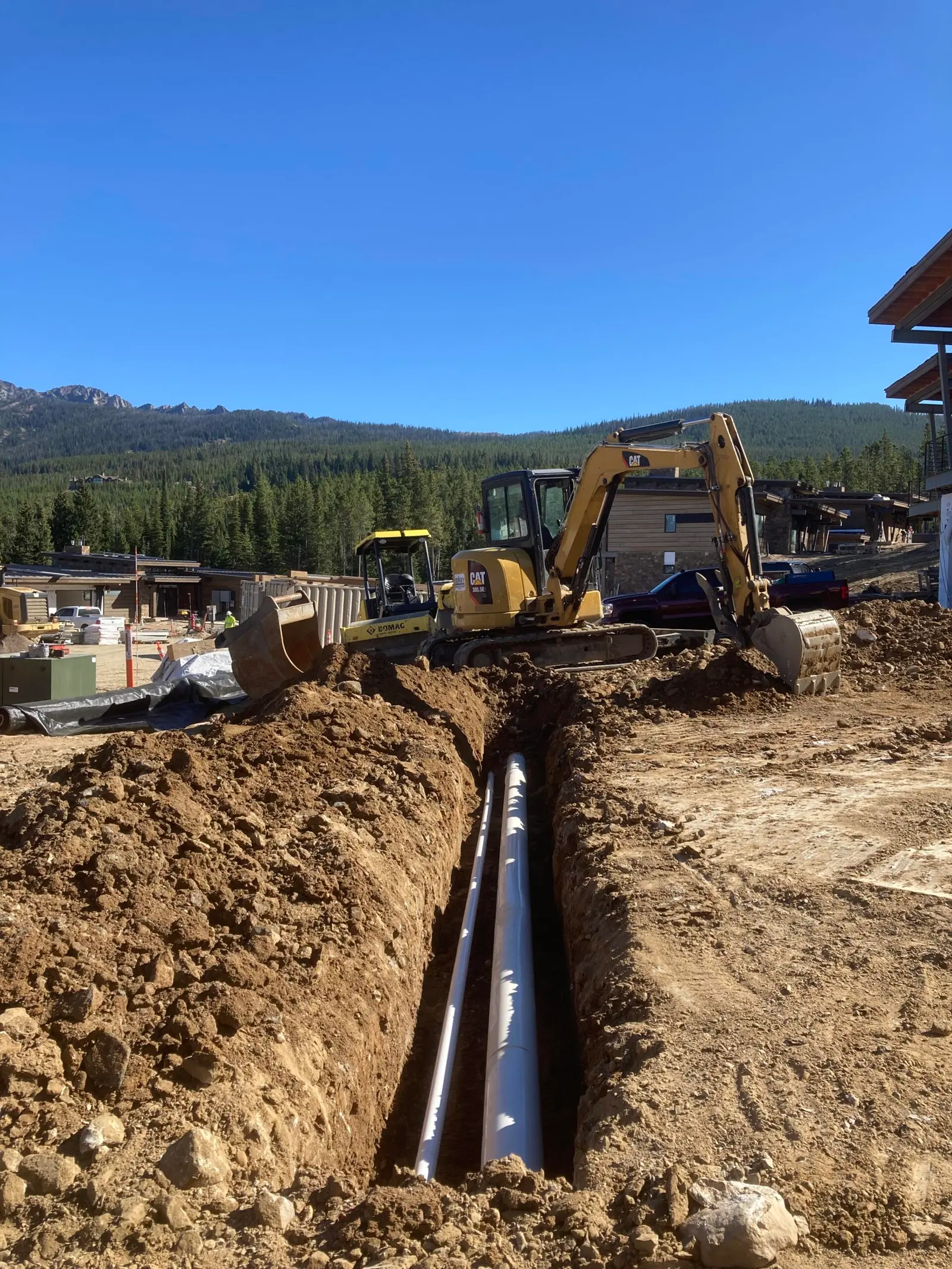
Some water can’t be fixed from the surface. A French drain collects it underground and walks it away.
French Drain Installation in Paradise Valley, Montana
A spring line seeping out of a hillside, a strip of yard that never firms up, groundwater leaning on a foundation wall from March to June — none of that responds to a shovel and a load of topsoil. That water moves below grade, usually riding on a tighter clay or till layer a few feet down, and surfaces wherever that layer does. EZ Road Repair installs French drains, curtain drains, and footing drains across Emigrant, Livingston, Pray, Chico, Gardiner, and the length of Paradise Valley. The pieces are simple; the details decide whether the drain still moves water in year ten.
When this matters
- A wet, mushy strip of yard or pasture that stays soft long after the rest has dried
- Groundwater or a hillside seep pushing at a foundation, crawlspace, or basement wall
- A driveway edge or low spot that stays saturated and heaves every winter
- A retaining wall or building cut with water stacking up behind it
- An older drain that worked once and quit — no fabric, no fall, nothing to show for it
What a French drain is actually made of
Four parts, each with its own predictable failure.
The trench runs across the path of the water, not along it, cut deep enough to get below the wet zone it’s meant to intercept. On a foundation it sits alongside and at or below the bottom of the footing, draining the soil the wall bears against instead of sitting up in backfill catching nothing.
The pipe is perforated and laid on continuous fall — roughly one percent is the working minimum, and it gets shot with an instrument, not eyeballed, because a pipe that dips is a pipe that ponds and freezes. Past the collector, the outlet run is solid pipe, so water leaving can’t leak back into the ground it came from.
The rock is washed, angular drain rock — not road mix, not pit run. That substitution is the most common and the most damaging: road mix is built to bind under traffic, the opposite of what a drain needs. Its fines fill the voids between stones, and a drain with no voids is a buried ditch full of dirt. It’s one reason we’re specific about what gets delivered.
The fabric is a nonwoven geotextile wrapped around the whole rock envelope, seams overlapped, so soil can’t migrate into the stone. Cheapest part of the job, and the one whose absence shows up first.
Where French drains go wrong
- No real outlet. A drain that doesn’t run continuously downhill to somewhere water can legally leave is a long, expensive bathtub. Gravity does not negotiate, and neither does the neighbor whose fence line you fire it at.
- Flat pipe. Water standing in the line freezes in January and the drain is out of service in the months it was built for.
- The outlet set too low or left bare. One daylighting below the ditch line backs up in high water; an unarmored one undercuts itself and slumps. It belongs above whatever it discharges into, screened against rodents, and armored where velocity warrants — see erosion control.
- Downspouts tied into the perforated run. Roof water dumped into the collector recharges the ground you’re trying to dry; it travels separately, in solid pipe.
- No cleanouts. Access at the ends and bends is what keeps a drain serviceable instead of disposable.
What Montana ground does to a drain
The benches around Emigrant and Pray sit on alluvial fan cobble that digs slow and drains fast — two feet lower on the same property you can hit the tight layer the water is riding on. River bottom near Livingston can carry a spring water table high enough that trench depth becomes a real decision rather than a default.
Frost is the other constraint. In spring the top foot thaws while the soil beneath stays frozen, so meltwater can’t percolate — it runs across ground that would swallow it in August. That’s the load the drain is built for, and why an outlet that freezes into a plug takes the system offline in exactly the season it was meant for.
How we approach it
We walk the water first — uphill of the wet spot, through it, and downhill to wherever it can legally and durably discharge. Sometimes the honest answer is that a French drain is the wrong tool: if the water runs on top, grading and leveling or a swale fixes it for less, and we’ll say so. A drain is one option inside a larger drainage plan.
When it is the right call, the sequence runs: locates before the bucket, then trench on grade with spoil kept downhill of the cut. Fabric lines the floor and walls, a bed of washed rock goes down, the pipe is set to grade on it, then more rock, then the fabric folds closed over the top — capped with topsoil and seed, or with rock to the surface if the drain also takes surface water. Perimeter and footing drains are far easier to build while the hole is open, so they get scheduled with the foundation or basement excavation rather than retrofitted later. Backfill goes in compacted lifts — the same discipline as utility trenching — so the line doesn’t reappear next year as a rut across the yard.
Serving Paradise Valley & Southwestern Montana
Based in Emigrant, we install French drains throughout Paradise Valley — Livingston, Pray, Gardiner, Chico — and the surrounding foothill, bench, and riverfront ground where groundwater does its best work.
Get a French drain estimate
Call (406) 623-9075 or request a quote. Tell us where the water shows up and what it’s threatening — a photo of the wet ground in April beats any description in August.
EZ Road Repair and Excavation — locally owned, Montana tough.