
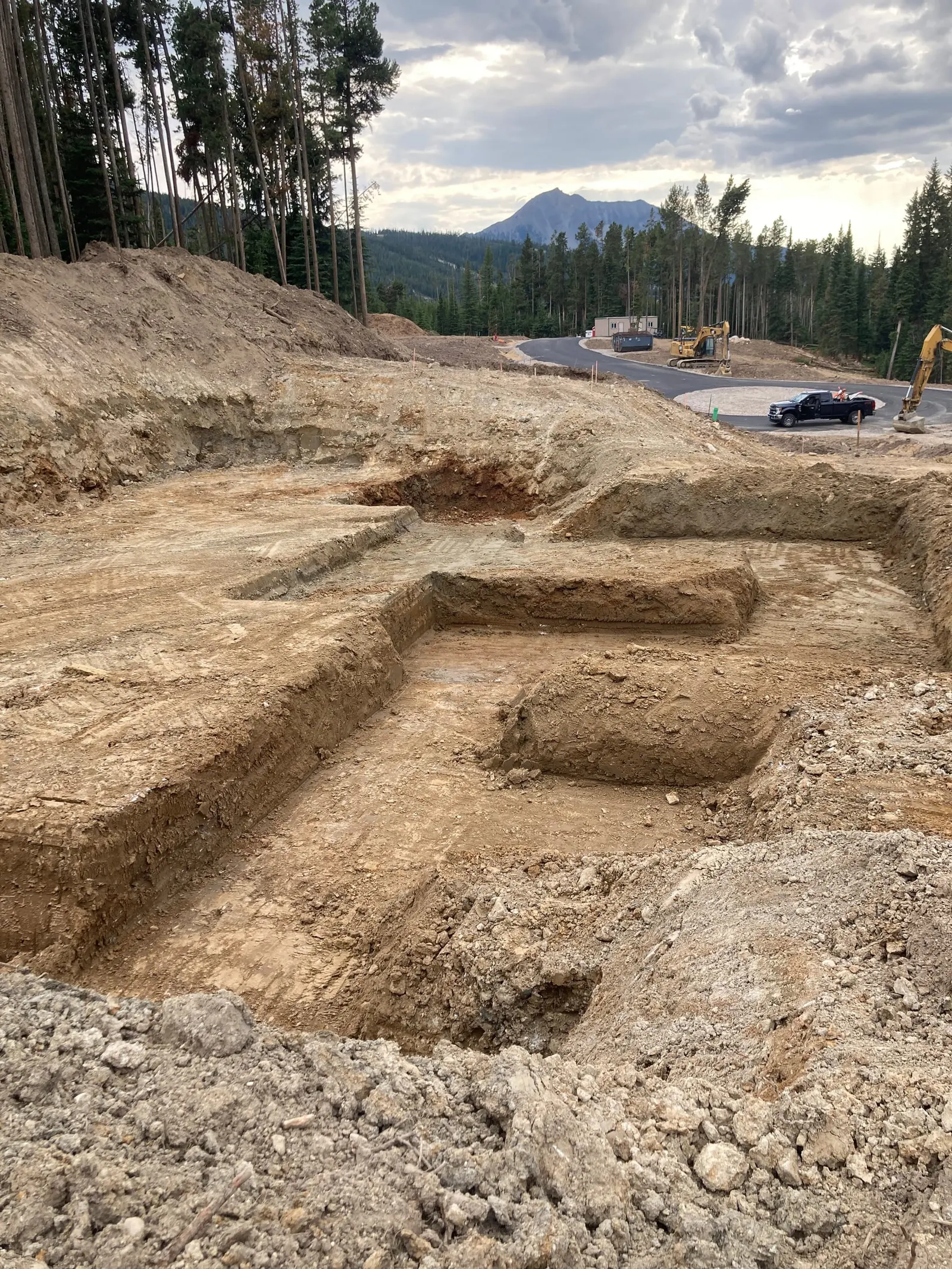
A basement is the deepest hole anyone will dig on your property — and the one you have to live on top of afterward.
Basement Excavation in Paradise Valley, Montana
EZ Road Repair digs basements and walkout lower levels across Emigrant, Livingston, Pray, Chico, and Gardiner, working from your builder’s foundation plan through final grade. A basement is the least forgiving dig on a homesite: it has to hit plan depth and grade, stand safely while a concrete crew works at the bottom of it, keep the ground under the footings firm and undisturbed, and get backfilled without pushing new walls out of plumb.
When this matters
- A new house with a full basement or a walkout lower level
- A sloped lot where a walkout turns grade change into finished living space
- A shop or barn with a partial sub-grade level, root cellar, or equipment pit
- A site with a high water table, a seasonal spring line, or cobble and bedrock near the surface
- A basement that took on water once and is being rebuilt with the drainage done right
Making a deep hole stand up
The hole is a temporary structure and deserves to be treated like one. Vertical walls in loose or saturated ground don’t stand on their own, and the general rule is that anything past about five feet deep gets protected — laid back to a safe slope, benched, or shored. Which one fits depends on the ground, and around here that changes fast. Valley-floor clay stands up beautifully until it gets wet, then slumps in slabs. Glacial cobble on the benches has almost no cohesion and ravels off a vertical face as fast as you cut it.
Sloping back and benching cost room, which surprises people. A ten-foot basement with laid-back walls can open a hole ten to fifteen feet wider than the foundation footprint on every side, and that has to be planned against the property line, the well, the drainfield area, and the trees you want to keep. We also overdig two to three feet outside the wall line so the form and waterproofing crews have room to work. Spoil goes well back from the edge: stacked at the lip of the cut it loads the soil holding the wall up, and the first hard rain washes it back into the hole.
Keeping the hole dry
Water arrives three ways here: groundwater, surface runoff off the slope above the house, and spring snowmelt — the biggest single water event most of these sites see all year.
Surface water gets handled above the hole, not in it: an interceptor ditch or swale uphill that catches slope runoff and carries it around the excavation. Groundwater gets pumped and routed to a discharge point away from the dig so footings bear on firm ground rather than soup. Concrete placed on a softened bottom is a settlement crack waiting to happen; no rebar fixes a bearing surface that was mud on pour day.
Then there’s the permanent system, the part that gets shortchanged on a lot of builds. Perimeter drain tile goes in at footing level, sloped, bedded in washed rock and wrapped in filter fabric so fines don’t blind it — and it has to actually go somewhere: daylight on a sloped lot, a sump on a flat one. A drain line that dead-ends is decoration. Paired with wall waterproofing and a grade that falls away from the house, that tile is the difference between a dry lower level and one that smells like a basement. Same crew and standard as our drainage work and French drain installation.
Where this goes wrong
- Backfilling too early. Green concrete and unbraced walls don’t resist lateral earth pressure. Backfill goes in after the concrete has cured and the floor deck or bracing is set per your builder — dirt pushed against a bare wall days after the pour is how walls crack and bow.
- Backfill dumped instead of built. Loose backfill keeps consolidating for years, leaving a settled trench around the house that slopes toward the wall you just waterproofed. It goes back in lifts, compacted.
- Frost-susceptible fill against the wall. Packing fine clay against a foundation where frost drives several feet down builds a jack against your own wall. Free-draining material near the wall is the fix.
- No plan for the finish grade. The dirt has to fall away from the foundation on every side — a few inches across the first ten feet is the usual target — and downspouts have to discharge past that.
- Digging too late in the season. A hole opened in late fall that catches snow and then freezes is a hole nobody pours in until spring.
How we approach it
We walk the site first — slope, soil, access for a loaded ready-mix truck, where the water goes, and where the spoil can live — and get utility locates before anything opens. Then we strip and stockpile topsoil for the final grade, cut to plan depth with the bearing surface left clean and undisturbed, and lay the walls back or bench them for the soil we actually find. Once the foundation is poured and waterproofed, we set drain tile and rock, backfill in compacted lifts, and finish the rough grading falling away from the house.
With the machine already on site, the rest of the dirt package costs far less in one mobilization: the driveway cut and the utility trenches, water lines below frost depth. Basement digs are the deep end of our foundation work; clearing, demolition, and full-lot scope live under site preparation.
Serving Paradise Valley & Southwestern Montana
Based in Emigrant, we dig basements throughout Paradise Valley — Livingston, Pray, Chico, Gardiner — and take on builds toward Bozeman and Big Timber.
Get a basement excavation estimate
Call (406) 623-9075 or request a quote. Send the foundation plan, or just the footprint and the lot’s slope, and we’ll walk the site, talk through depth, spoil, and water, and coordinate timing with your builder.
EZ Road Repair and Excavation — locally owned, Montana tough.