
Water at the Foundation Is a Delivery Problem, Not a Wall Problem
If water stands against your house after a storm, or the crawlspace smells damp every May, water is arriving at the foundation faster than the ground can carry it away. The fix is almost always outside the house — in the shape of the ground and what is buried beside it — not in coatings or sealers applied to the wall.
Two different kinds of water cause it, and they need two different responses. Surface water runs across the ground: roof runoff, snowmelt sheeting off a hillside, the neighbor’s field shedding toward your building. Subsurface water moves through the soil itself, following gravel lenses and, very often, the backfill trench around your own foundation wall — which on most builds is looser and more permeable than the undisturbed ground beside it. That trench acts like a bathtub. A French drain intercepts that second kind of water. Grading and swales handle the first. Treating one when the problem is the other is the most common reason a drainage repair does not hold.
What Montana adds to the problem
Around Emigrant and Pray, most of the water arrives in a few concentrated weeks. Snowmelt comes off frozen ground that cannot absorb it, so volumes a lawn would soak up in August sheet straight across the surface in April. Frost depth matters too: a shallow drain frozen solid in January is useless exactly when the March thaw starts loading it. Soils also vary enormously over short distances — alluvial gravel along the river drains freely, while bench and clay ground a quarter mile away holds water for weeks. The same design succeeds on one property and fails on the next.
Freeze-thaw is what turns a nuisance into structural damage. Saturated soil against a footing expands as it freezes, lifts, then drops when it thaws. Repeat that through a winter and you get cracked footings and out-of-plumb walls.
How the work actually gets figured out
Good drainage work starts with tracing the water, not with digging.
- Find the source. Roof, slope, road ditch, upslope neighbor, or a water table that rises seasonally. Each one calls for a different intercept point.
- Read the grade. We shoot elevations to find where the ground actually falls — which is frequently not where it looks like it falls.
- Confirm an outlet. Before anything else, we identify where the water will end up: a daylight outlet on lower ground, an existing ditch, or a culvert crossing.
- Pick the intercept line. Usually uphill of the structure, deep enough to catch water below the wet zone.
- Build it to keep working. Perforated pipe bedded in clean washed rock, wrapped so fines cannot migrate in, with consistent fall the whole run.
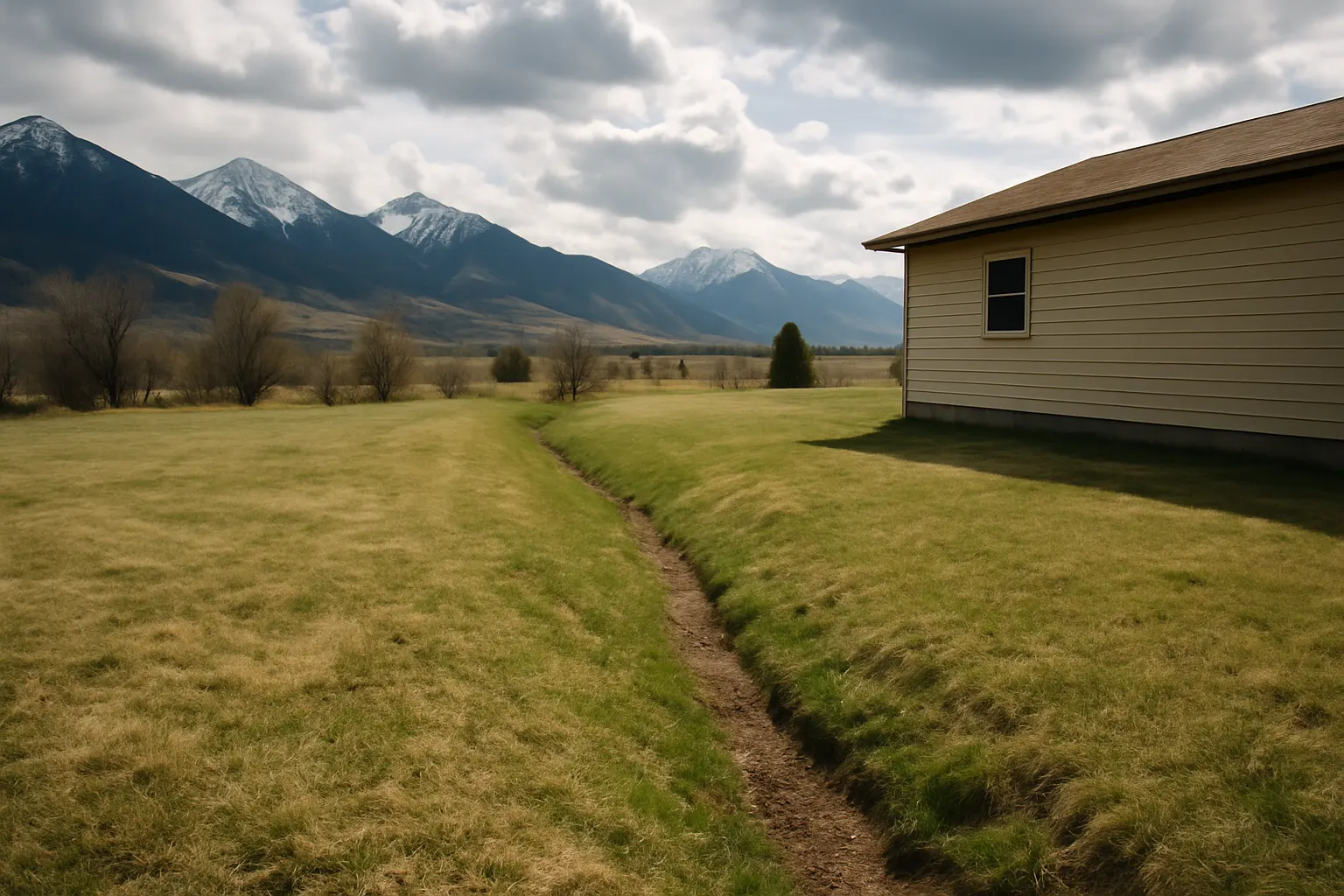
What you can check yourself
| What you see | Usually means | What it points to |
|---|---|---|
| Puddle sitting against the wall a day after rain | Ground slopes toward the house | Regrading, not a drain |
| Damp crawlspace only during snowmelt | Seasonal high water or upslope runoff | Intercept drain uphill of the structure |
| Erosion channel cut across the yard | Concentrated surface flow with nowhere to go | A swale or shaped ditch |
| Soft spongy strip over an old drain line | Trench has silted in or pipe has failed | Excavate and rebuild that section |
| Efflorescence or white staining on the crawlspace wall | Water moving through the concrete | Subsurface water at the footing |
Where these jobs go wrong
The biggest failure is an outlet that does not exist. A drain that ends in a buried gravel pocket on flat ground is a storage tank, and once it fills it stops collecting. The second is using pit-run or dirty gravel around the pipe: the fines wash in, plug the voids, and the drain quietly dies in a few seasons. The third is dumping the water ten or fifteen feet away, where it soaks back down and returns through the same soil. And the fourth is the sealer-and-hope approach — waterproofing the wall from outside while leaving the hydrostatic pressure that is pushing water into it.
What drives scope and timing
Depth is the largest factor. A drain reaching below a full basement wall means more excavation, more spoil, and shoring considerations a shallow crawlspace drain does not have. Access matters next — whether a machine can reach the trench line without crossing a septic field, a finished lawn, or a tight side yard. Then distance to a workable outlet, whether spoil can be spread on site or must be hauled, and how much rock the run needs. Rocky ground slows trenching; running water in the trench slows it further. If the work ties into site grading or a foundation excavation, doing it in one mobilization is far more efficient than coming back.
Timing favors late summer through early fall: water tables are down, the ground is workable, and the drain settles in before the next runoff. Spring is the worst time to trench and the best time to diagnose — walk the property during the melt and photograph where water actually runs. That is the information a contractor most wants and can never see in July.
For the broader picture of how a drain fits with ditches, culverts, and runoff paths across a whole property, the Montana rural drainage guide covers how the pieces connect.
Get eyes on it before the next melt
If you can point at where the water shows up, we can usually tell you within a site visit whether you are looking at a grading fix, a drain, or both. Request a free estimate or call (406) 623-9075, and we will walk the ground with you and trace where it is coming from.
Have a project in mind?
EZ Road Repair handles road building, excavation, drainage, masonry, and snow work across Paradise Valley and Southwestern Montana.