
The pile becomes the obstacle
By February, a lot that plowed easily in November can be down a quarter of its parking, with banks tall enough that the machine is stacking uphill and half of what goes up rolls back down. Nothing is wrong with the plowing. The snow already on the ground has simply become the thing in the way, and no amount of pushing fixes that.
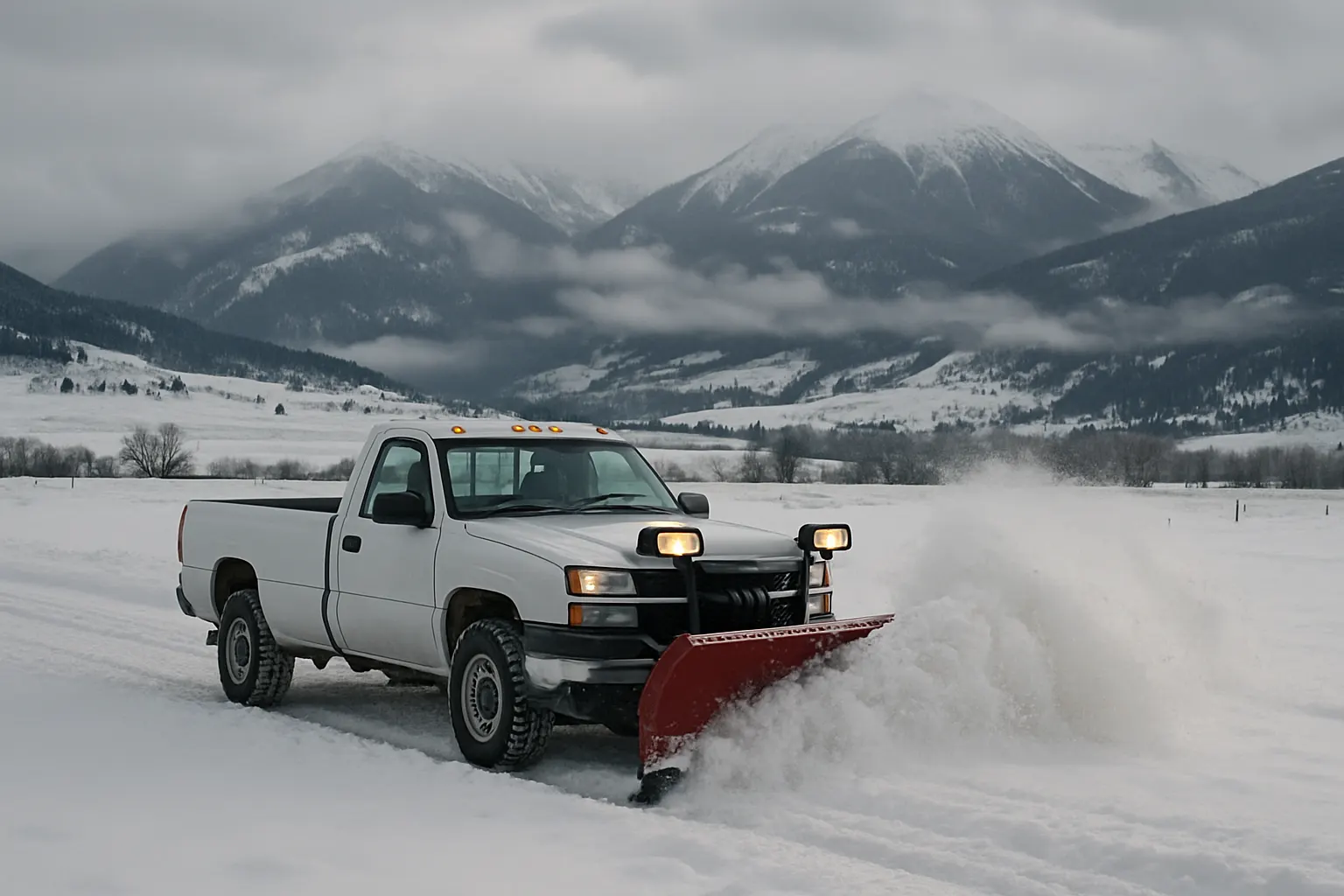
Pushing moves snow to the edge of the property or to a storage area on it. Hauling loads that snow and takes it off the property entirely. Most of a Montana winter is pushing, because pushing is faster and cheaper and there is usually somewhere to put it. Snow hauling and pile removal is the relief valve for when there is not.
Why Montana piles get harder, not just bigger
A snowbank in Paradise Valley is not fluffy powder. It has been bladed, stacked, and restacked, so it compacts under its own weight. Then freeze-thaw goes to work on it: sun off the south face melts the surface through the afternoon, the temperature drops after dark, and the face refreezes into a glaze. Repeat that a dozen times and you have a dense, ice-layered mass that a plow blade will bounce off. That is why a pile you could have shoved back in January takes a loader in March.
The meltwater matters as much as the pile. It runs to the low point, refreezes overnight, and lays sheet ice exactly where people walk and turn. A pile parked uphill of a shop door or a house is a slow-motion drainage problem, and a pile sitting on a catch basin, ditch, or culvert inlet plugs the very path the water needs during runoff. Snow piles also outlast everything around them, holding mud in one corner of the lot for weeks after the rest has dried, which pushes back spring grading and repairs. If your site already struggles with water, the Montana rural drainage guide covers where that runoff is supposed to go.
Signs it is time to haul rather than push
- Parking or turnaround space you actually need is now under snow.
- Sightlines at an exit, a corner, or a driveway approach are blocked.
- The banks are taller than the machine can lift cleanly, so snow rolls back.
- Meltwater from a pile is icing a walkway, door, or driving lane.
- A pile is sitting over a culvert inlet, a ditch, a swale, or a drain.
- Piles are crowding fire lanes, hydrants, utility pedestals, or propane fills.
- There is nowhere left to put the next storm, and the forecast has one in it.
How the call gets made on site
We walk the property first and look at what storage is genuinely left, not what looked available in the fall. Then slope and drainage: where melt travels, what it crosses, and where it will refreeze. Then sightlines and access, including fire lanes and delivery routes. Last is the mechanical question of whether a machine can even work the piles where they sit and whether a truck can stage beside it with clear overhead.
That usually produces one of three answers. Push the banks back, if there is still room behind them and the snow has not frozen solid. Relocate the piles to a better spot on the property, which is often enough on acreage where the problem is placement rather than volume. Or load and haul it off, which is the answer for tight commercial lots, shared roads, and anywhere the property is simply out of room.
Mistakes that make it worse
The common one is waiting. A pile handled during a midwinter thaw is loose and quick; the same pile in March is frozen through and takes twice the machine time. Second is placement: piling on the uphill side of a building, on a drainfield where the compaction does real damage, or over the drainage structures that have to work in April. Third is treating hauling as a substitute for a plan. If a lot runs out of room every year, the fix is a storage area chosen deliberately in the fall, not an emergency clear-out every March.
What drives scope
Volume and density lead: dry January snow loads faster than an ice-laminated March bank. Haul distance and the availability of a dump site come next, then staging room, then hours of operation, since lots that cannot be closed during business get worked at night. Access is the quiet one, because a pile a loader cannot reach costs more than a bigger pile it can.
Sites with steady traffic tend to fold this into a plowing agreement so the pile question gets handled before it becomes urgent. See how it fits with seasonal plowing contracts, or with routine commercial plowing for lots and shared roads.
Running out of room on a lot or driveway around Livingston, Emigrant, or Paradise Valley? Call (406) 623-9075 or request a free estimate and we will tell you honestly whether pushing the banks back gets you through the season or the snow needs to leave.
Have a project in mind?
EZ Road Repair handles road building, excavation, drainage, masonry, and snow work across Paradise Valley and Southwestern Montana.